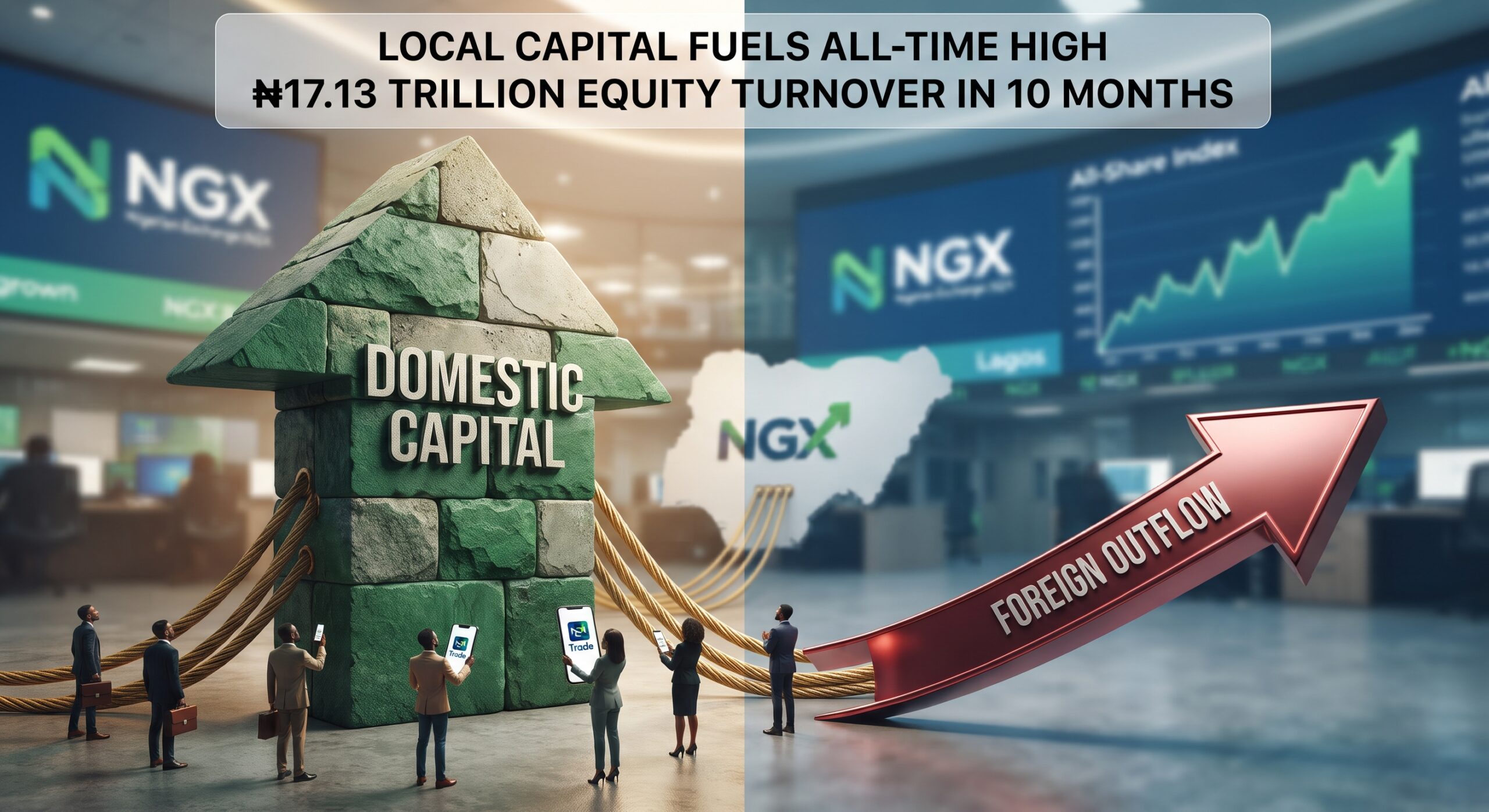
For decades, the narrative surrounding the Nigerian equities market followed a predictable script. Whenever foreign portfolio investors (FPIs) arrived with cheap global liquidity, stock prices rallied and daily trading volumes surged. Whenever external shocks, currency volatility, or election jitters prompted offshore funds to head for the exits, the market endured prolonged droughts, steep valuations discounts, and sluggish liquidity. That script has been decisively rewritten in 2026.
Data from the Nigerian Exchange Limited (NGX) for the ten-month period ended October 2026 reveals a historic milestone: total equity market turnover climbed to an all-time record of ₦17.13 trillion, representing a remarkable 79% surge compared to the corresponding period in 2025. Even more significant than the headline volume is the engine powering it. Domestic investors accounted for 90.29% of all transactions executed on the exchange during the period, easily absorbing net foreign outflows of ₦289.67 billion and demonstrating that indigenous capital has become the undisputed anchor of Nigeria’s capital market.
This structural shift marks a watershed moment for West Africa’s largest stock exchange. Understanding what drove this ₦17.13 trillion milestone, which domestic investor segments stepped up, how corporate fundamentals and banking recapitalization catalyzed trading activity, and what this resilience means for future capital formation provides critical insight into the evolution of Nigeria’s financial ecosystem.
Deconstructing the ₦17.13 Trillion Milestone
To appreciate the scale of the 2026 achievement, it is helpful to examine the composition of flows recorded by the NGX between January and October 2026. Total market transactions reached ₦17.13 trillion, eclipsing full-year records from previous cycles with two full months of trading still remaining in the calendar year.
| Market Metric (Jan – Oct 2026) | Value / Share | Year-on-Year Context & Significance |
| Total Equity Turnover | ₦17.13 trillion | All-time 10-month record; up ~79% year-on-year |
| Domestic Transaction Value | ₦15.47 trillion | Represents 90.29% of total market activity |
| Foreign Transaction Value | ₦1.66 trillion | Represents 9.71% of total market activity |
| Foreign Inflows | ₦687.08 billion | Selective offshore participation in blue-chip counters |
| Foreign Outflows | ₦976.75 billion | Profit-taking and pre-election de-risking |
| Net Foreign Position | -₦289.67 billion | Fully absorbed by domestic institutional and retail demand |
In historical bull runs on the NGX, such as those witnessed in 2007 or 2013, foreign participation routinely accounted for between 45% and 60% of monthly market turnover. In 2026, that ratio has inverted completely. Domestic investors generated approximately ₦15.47 trillion in transaction value across the ten-month window, dwarfing the ₦1.66 trillion in combined foreign inflows and outflows.
Rather than triggering a market-wide sell-off or liquidity freeze, the ₦289.67 billion net foreign withdrawal created entry opportunities for local institutions looking to accumulate fundamentally sound equities at attractive earnings multiples. As offshore funds trimmed exposure ahead of Nigeria’s 2027 general election cycle and rotated toward higher-yielding global fixed-income assets, Nigerian institutions and retail participants stepped in as eager liquidity providers.
Who Are the Domestic Powerhouses Driving the Surge?
The 90.29% domestic share is not a monolith. It reflects the convergence of deep institutional pools of capital, aggressive proprietary trading desks, corporate strategic buyers, and a digitally empowered generation of retail investors.
1. Pension Fund Administrators (PFAs)
Nigeria’s contributory pension industry, supervised by the National Pension Commission (PenCom), sits at the heart of this domestic revolution. With total pension assets expanding steadily on the back of monthly employer and employee contributions, PFAs command trillions of naira in long-term investable funds.
While fixed-income instruments still comprise the largest portion of pension portfolios, persistent inflationary pressures over recent years forced pension fund managers to seek real inflation-beating returns. High-dividend-paying equities in banking, telecommunications, fast-moving consumer goods (FMCG), and energy emerged as vital tools for preserving purchasing power. Furthermore, regulatory revisions and improved risk-management frameworks encouraged PFAs to deploy larger allocations into fundamentally resilient tier-one equities, providing steady, non-speculative demand throughout 2026.
2. Domestic Asset Managers and Mutual Funds
Collective investment schemes regulated by the Securities and Exchange Commission (SEC) have experienced substantial growth in assets under management. Equity-focused mutual funds, balanced funds, and ethical funds managed by leading Nigerian investment houses actively rotated capital across sectors in 2026, capturing momentum in banking, industrial goods, and oil and gas stocks.
Because domestic asset managers benchmark their performance against the NGX All-Share Index (ASI) and local inflation, sitting on idle cash during an equity rally carries high career and performance risk. This dynamic reinforced continuous portfolio rebalancing and active secondary-market trading.
3. High-Net-Worth Individuals (HNIs) and Family Offices
Nigerian high-net-worth investors and domestic family offices have historically favored real estate and foreign currency holdings. However, exchange rate stabilization following earlier currency reforms, combined with extraordinary dividend yields and capital appreciation on the NGX, drew substantial private wealth back into local equities.
Many HNIs utilized discretionary portfolio management mandates and block-trade facilities to build sizable stakes in undervalued industrial, agricultural, and financial stocks, contributing significantly to large-volume off-market and on-exchange negotiated deals.
4. Retail Investors and Digital Trading Platforms
Perhaps the most dynamic shift in market structure has come from retail participation. Over the past few years, fintech-driven brokerage apps, mobile trading portals, and simplified Know-Your-Customer (KYC) onboarding processes have dismantled traditional barriers to entry on the NGX.
Younger, tech-savvy Nigerians increasingly view equities alongside treasury bills and money market funds as accessible wealth-building vehicles. During major public offers, rights issues, and dividend qualification windows in 2026, retail order volumes surged, adding vital day-to-day liquidity and narrowing bid-ask spreads across mid-cap and large-cap counters.
Five Catalysts Behind the 2026 Liquidity Boom
Record turnover does not happen in a vacuum. Five distinct macroeconomic, regulatory, and corporate catalysts converged during the first ten months of 2026 to supercharge equity market velocity.
1. The Banking Sector Recapitalization Wave
The Central Bank of Nigeria’s (CBN) banking recapitalization directive acted as the single largest structural catalyst for capital market activity. As commercial banks raced to meet heightened minimum paid-up capital thresholds ahead of regulatory deadlines, the NGX became the primary arena for capital raising, rights issues, public offers, and secondary-market repositioning.
Investors actively traded banking shares to arbitrage pricing differentials between secondary market prices and primary offer prices, reposition portfolios ahead of dilution, and accumulate shares in tier-one lenders demonstrating strong capital-raising execution. Financial services stocks consistently accounted for the lion’s share of daily volume and value traded, with top banking groups delivering blockbuster nine-month 2026 earnings that further validated investor appetite.
2. Corporate Earnings Resilience and Generous Dividend Payouts
Despite macroeconomic headwinds, Nigeria’s leading listed corporates demonstrated remarkable operational adaptability in 2026. Nine-month financial results released in October 2026 highlighted robust profit growth across tier-one banks, upstream energy producers, telecom operators, and agribusinesses.
Specifically, Nigeria’s five largest banking groups posted combined profit after tax of approximately ₦2.91 trillion for the nine months ended September 2026. Strong earnings translated directly into attractive interim and full-year dividend declarations. In a market where domestic investors prioritize tangible cash distributions, dividend yield plays triggered intense buying momentum around qualification and markdown dates.
3. The September 2026 Monetary Policy Pivot
For much of 2024 and early 2025, ultra-high yields on Nigerian Treasury Bills and Open Market Operations (OMO) bills created stiff competition for equities, keeping conservative investors parked in short-term money market instruments. That dynamic began to shift when disinflation progress allowed the CBN Monetary Policy Committee (MPC) to deliver a 350-basis-point rate cut in September 2026, lowering the Monetary Policy Rate (MPR) to 23.00%.
As primary auction rates on government bills moderated from their earlier peaks, institutional and retail asset allocators rotated incremental liquidity out of maturing money market instruments and into undervalued equities offering superior total-return potential.
4. Currency Stabilization and Corporate Balance Sheet Recovery
Following the painful foreign exchange adjustments of 2023 and 2024 that saddled several multinational and consumer goods companies with heavy unrealized FX losses, relative stability on the Nigerian Foreign Exchange Market (NFEM) during much of 2026 allowed corporate balance sheets to heal.
Companies in the consumer goods, manufacturing, and telecom sectors returned to profitability as exchange rate predictability improved input cost planning and eliminated massive quarterly revaluation write-downs. Investors rushed to re-rate these turnaround stories, generating heavy trading turnover in industrial and consumer counters that had previously been oversold.
5. Strategic Block Trades and Institutional Restructuring
A notable portion of the ₦17.13 trillion turnover was propelled by large off-market and negotiated cross deals. Corporate reorganizations, holding company transitions, strategic stake acquisitions in the energy and financial sectors, and cross-border divestments in the oil and gas industry generated multi-billion-naira single-day transaction spikes on the NGX.
Sectoral Breakdown: Where the Money Flowed
While trading breadth improved noticeably in 2026 compared to prior years, capital concentration remained heaviest in four core sectors that anchor the NGX All-Share Index.
Financial Services: The Undisputed Liquidity Engine
Banking and insurance stocks consistently dominated daily activity charts, frequently representing over 60% of total market volume and roughly half of transaction value. Tier-one names such as Zenith Bank, Guaranty Trust Holding Company (GTCO), Access Holdings, United Bank for Africa (UBA), and First HoldCo attracted relentless institutional turnover due to their deep free floats, strong earnings momentum, and recapitalization milestones.
Oil and Gas: Domestic Acquisition Momentum
The upstream and downstream petroleum sector experienced a renaissance on the exchange. Ongoing asset divestments by international oil companies (IOCs) to indigenous energy champions transformed the earnings profile and reserve base of listed Nigerian energy firms. Investors aggressively repriced upstream producers and integrated energy companies, driving sharp rallies and heavy institutional block trading.
Industrial Goods and Cement
Major cement manufacturers and industrial conglomerates benefited from sustained federal and state infrastructure spending, housing construction demand, and export expansion across West Africa. Although tighter free floats in some heavyweight industrial stocks limited daily share volumes, high unit share prices meant that even moderate block trades contributed substantially to overall naira turnover.
Telecommunications and Agribusiness
Telecom giants remained core institutional holdings due to tariff adjustments, surging data consumption, and mobile money expansion. Meanwhile, listed palm oil and rubber producers enjoyed strong investor patronage as local commodity pricing and import substitution policies boosted margins and dividend payouts.
Why Domestic Dominance Is a Game-Changer for Nigeria
The transition from a foreign-dependent stock market to a domestically anchored powerhouse carries profound strategic benefits for Nigeria’s broader economy.
| Dimension | Foreign-Dominated Market Era | Domestic-Anchored Market Era (2026) |
| Liquidity Stability | Prone to sudden stops when global rates rise | Cushioned by recurring pension and retail inflows |
| Currency Vulnerability | Equity sell-offs trigger immediate FX demand | Local-to-local transactions put zero direct pressure on reserves |
| Valuation Anchor | Driven by global frontier-market index weightings | Grounded in domestic earnings, dividends, and inflation hedging |
| Capital Raising Capacity | Dependent on international roadshows and foreign appetite | Proven ability to absorb multi-trillion-naira domestic offers |
| Market Depth | Concentrated in 5 to 8 foreign-eligible blue chips | Expanding breadth across mid-caps, energy, and agribusiness |
1. Insulation Against Global Capital Flight
In emerging and frontier markets, reliance on short-term foreign portfolio capital often creates boom-and-bust cycles driven by decisions made in Washington, London, or Tokyo rather than domestic economic fundamentals. When domestic institutions control over 90% of equity turnover, the NGX gains structural shock absorbers. Foreign investors can still enter and exit freely, providing healthy price discovery, without destabilizing the entire financial system when they leave.
2. Reduced Feedback Loops Between Equities and the Naira
When offshore funds liquidate naira equities, they immediately convert the proceeds into US dollars, amplifying pressure on the foreign exchange market. Conversely, when Nigerian PFAs, mutual funds, and retail investors buy and sell shares among themselves, liquidity circulates within the domestic banking system without creating direct demand for central bank reserves.
3. Enhanced Capacity for Domestic Capital Formation
A deep, liquid local equity market proves that Nigerian businesses do not need to rely exclusively on foreign markets or expensive commercial bank loans to finance expansion. The success of major banking capital raises in 2026 demonstrated that domestic pools of capital can mobilize trillions of naira for productive enterprise when instruments are transparently structured and fairly priced.
Challenges and Risks That Require Vigilance
Celebrating the ₦17.13 trillion milestone should not obscure structural vulnerabilities that policymakers and market operators must address to sustain momentum into 2027 and beyond.
High Market Concentration and Free-Float Constraints
A small handful of heavyweight stocks still accounts for a disproportionate share of the NGX’s total market capitalization and daily turnover. Several large industrial and telecom companies maintain relatively narrow public free floats, which can limit institutional participation and distort index movements. Encouraging wider public shareholding and enforcing free-float compliance remain essential for balanced market depth.
Pre-Election Volatility and Fiscal Pressures in 2027
As Nigeria moves closer to the 2027 general elections, heightened political spending and policy uncertainty could trigger episodes of volatility. If government borrowing increases sharply to fund pre-election expenditures, upward pressure on Treasury bill and bond yields could temporarily divert domestic liquidity back away from equities.
Paucity of New Listings Across High-Growth Sectors
While the banking recapitalization injected fresh capital into existing listed institutions, the NGX still lacks sufficient representation from high-growth segments of the Nigerian economy, including technology startups, fintech unicorns, mid-stream gas infrastructure, logistics, and healthcare. Attracting landmark initial public offerings (IPOs) from state-owned enterprises and leading private-sector champions is vital to broadening the investable universe for growing pension assets.
Inflation-Adjusted Real Returns
Even with nominal turnover hitting ₦17.13 trillion, domestic investors remain acutely focused on real returns after accounting for inflation. Sustaining long-term retail and institutional enthusiasm requires continued macroeconomic discipline, disinflation progress, and consistent corporate earnings growth that outpaces consumer price increases.
What Comes Next for the Nigerian Exchange?
Crossing ₦17.13 trillion in equity turnover within ten months is more than a statistical record; it is proof of concept for an indigenous capital market model. By proving that local savings can absorb nearly ₦290 billion in foreign outflows while propelling market liquidity up 79%, Nigerian investors have fundamentally altered the risk profile of the NGX.
Looking toward 2027, the foundations laid in 2026 position the exchange for its next phase of evolution. Completing the banking recapitalization exercise will leave Nigeria with stronger, better-capitalized financial institutions capable of funding large-scale industrial and infrastructure projects. Simultaneously, deepening retail onboarding, expanding derivatives and securities lending products, and incentivizing landmark IPOs will ensure that domestic capital continues to compound wealth at home.
For decades, analysts asked when foreign investors would return to rescue the Nigerian stock market. The 2026 trading data delivers an unmistakable answer: Nigeria’s market no longer needs rescuing. Powered by its own pension funds, asset managers, entrepreneurs, and retail savers, local capital has taken the wheel.