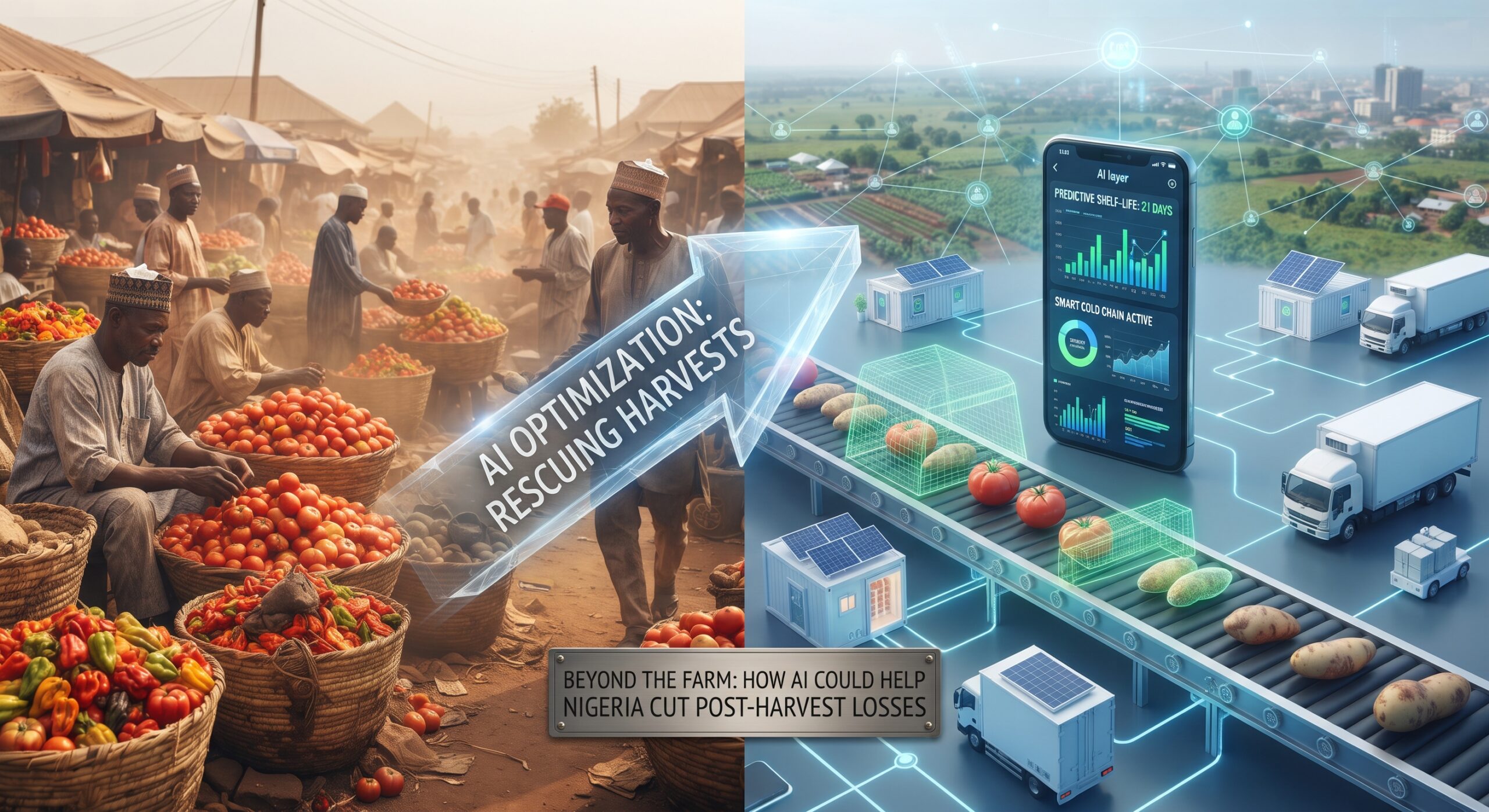
For generations, agricultural policy and technological innovation in Nigeria have focused predominantly on the upstream end of the farming cycle. Billions of naira have been channeled into improving seed varieties, expanding fertilizer distribution, mechanizing land preparation, and increasing yields per hectare. Yet, a silent economic hemorrhage continues to undermine these gains the moment crops leave the soil. Across Nigeria’s agricultural corridors, vast quantities of harvested tomatoes, yams, grains, fruits, fish, and vegetables rot in transit, spoil in rudimentary storage facilities, or lose commercial value before ever reaching a consumer’s plate.
The scale of this crisis is staggering. Conservative industry estimates place Nigeria’s annual post-harvest losses between ₦3.5 trillion and ₦5 trillion, representing roughly 30 to 40 million metric tones of wasted food every single year. Broader economic assessments suggest the total value lost across fragmented supply chains could reach even higher when factoring in lost agro-processing potential and multiplier effects. In a nation grappling with food inflation and nutrition insecurity, this is not merely an agricultural inefficiency; it is a macroeconomic emergency.
While physical infrastructure such as paved rural roads, reliable grid electricity, and modern cold storage warehouses remains indispensable, brick-and-mortar investments alone take years and massive capital outlays to scale. Artificial Intelligence (AI) offers a transformative, software-first layer of intelligence that can optimize existing infrastructure, predict spoilage before it happens, synchronize fragmented supply chains, and turn reactive farming into a precision-driven food system. Moving beyond the farm gate, AI is emerging as one of Nigeria’s most practical tools to rescue harvested food and unlock trapped economic value.
The Anatomy of Nigeria’s Post-Harvest Crisis
To understand how artificial intelligence can intervene effectively, it is necessary to examine where and why food disappears between harvest and consumption. According to data from the Federal Ministry of Agriculture and Food Security, post-harvest losses in Nigeria average between 5% and 20% for grains, approximately 20% for fish, and a devastating 50% to 60% for perishable tubers, fruits, and vegetables.
| Crop Category |
Estimated Post-Harvest Loss Rate |
Primary Causes of Loss |
| Perishables (Tomatoes, Peppers, Fruits) |
50% – 60% |
Lack of cold chain, heat stress, woven raffia basket crushing, transit delays |
| Roots and Tubers (Yams, Cassava) |
40% – 55% |
Bruising during harvest, poor curing, fungal rot, moisture buildup in stores |
| Fish and Livestock Products |
~20% – 30% |
Power outages in cold rooms, inadequate insulated transport, slow market off-take |
| Grains and Cereals (Maize, Rice, Sorghum) |
5% – 20% |
Weevil and pest infestation, aflatoxin contamination, improper drying |
The losses stem from five interconnected bottlenecks:
-
Harvest Timing Mismatches: Many smallholder farmers harvest crops based on visual guesswork or immediate cash needs rather than optimal physiological maturity or market readiness, resulting in produce that spoils rapidly in transit.
-
Primitive Packaging and Handling: In the northern tomato belt spanning Kano, Kaduna, and Plateau states, delicate produce is still routinely packed into rigid, poorly ventilated raffia baskets stacked high on open-bed trucks, crushing lower layers during multi-day journeys to southern markets like Lagos and Port Harcourt.
-
Cold Chain Deficits: Nigeria possesses only a fraction of the temperature-controlled storage capacity required for its agricultural output. Where cold rooms exist, erratic power supply and poor temperature monitoring frequently break the cold chain.
-
Opaque Market Linkages: Without real-time visibility into regional demand and pricing, farmers and middlemen often transport perishable goods to already oversupplied urban markets, leaving excess produce to rot when buyers cannot be found in time.
-
Pest and Mycotoxin Proliferation: In grain storage facilities, undetected spikes in humidity and temperature trigger rapid mold growth and aflatoxin contamination, rendering thousands of tones of maize and groundnuts unsafe for human consumption or export.
Six Ways AI Can Rescue Nigeria’s Harvests
Artificial intelligence does not replace the need for cold trucks or silos, but it dramatically multiplies their efficiency. By combining computer vision, machine learning, predictive analytics, and Internet of Things (IoT) sensors, AI systems can guide decisions across every link of the post-harvest value chain.
1. Predictive Harvest Scheduling and Shelf-Life Estimation
Post-harvest preservation begins before the crop is even cut or picked. AI models trained on satellite imagery, localized weather forecasts, soil moisture data, and crop phenology can pinpoint the exact window when a crop reaches peak harvest readiness.
Once harvested, computer vision algorithms deployed via standard smartphone cameras can assess produce maturity, firmness, surface bruising, and early-stage fungal infection in seconds. Pilot initiatives in major production hubs such as Jos, Plateau State, have already demonstrated how AI-driven image analysis can evaluate tomato quality and accurately quantify post-harvest deterioration along the supply chain. By assigning a dynamic “remaining shelf-life score” to each batch of produce, aggregators can route shorter-shelf-life batches to nearby processors or local markets while reserving hardier, longer-lasting batches for long-haul interstate transport.
2. Smart Cold Chain Management and IoT Optimization
Cold storage operators in Nigeria face steep diesel and solar energy costs alongside frequent ambient temperature spikes. Integrating AI with low-cost IoT temperature, humidity, and ethylene gas sensors inside solar-powered cold hubs and refrigerated trucks transforms passive cooling into intelligent preservation.
Machine learning algorithms continuously analyze thermal fluctuations, door-opening frequency, and external weather conditions to dynamically adjust compressor cycles. This reduces energy consumption while preventing micro-climatic hotspots that accelerate spoilage. Furthermore, predictive maintenance models monitor compressor vibrations and power draw, alerting technicians to impending equipment failures days before a breakdown occurs and ruins millions of naira worth of stored produce.
3. Intelligent Logistics and Dynamic Route Optimization
When trucks carrying perishable goods spend days stuck in gridlock along major transit corridors or break down on deteriorated highways, heat and vibration destroy cargo value. AI-powered logistics platforms address this vulnerability by synthesizing real-time traffic telemetry, road condition reports, weather patterns, and vehicle diagnostics.
Routing algorithms calculate the fastest, smoothest transit paths rather than merely the shortest distance, minimizing mechanical bruising and transit duration. On the aggregation side, AI load-matching engines consolidate partial harvests from dozens of smallholder farmers along a single corridor into full truckloads, lowering per-unit transport costs and eliminating the delays farmers face while waiting days to fill a commercial vehicle.
4. Demand Forecasting and Dynamic Market Matching
A massive share of post-harvest waste occurs because supply moves blindly toward traditional wholesale hubs regardless of real-time absorption capacity. AI demand-forecasting models ingest historical market prices, seasonal consumption trends, festival calendars, urban retail inventory data, and macroeconomic indicators to predict regional food demand weeks in advance.
Digital marketplace platforms powered by these algorithms connect farmer cooperatives directly with off-takers, food processors, supermarkets, and institutional buyers before harvest occurs. If predictive models detect an impending tomato glut in Mile 12 Market in Lagos, the platform can automatically alert aggregators in Kaduna to redirect shipments toward processing plants in neighboring states or adjust pricing dynamically to accelerate off-take before spoilage sets in.
5. Automated Grading, Sorting, and Aflatoxin Detection
In grain and tuber value chains, contamination in a small fraction of a harvest can ruin an entire warehouse batch. Traditional manual sorting is slow, subjective, and incapable of detecting internal defects or early microbial activity.
AI-enabled optical sorters and near-infrared (NIR) spectroscopy tools integrated with machine learning can inspect grains, cocoa beans, cashews, and tubers at high speeds. These systems identify subtle color variations, moisture anomalies, and spectral signatures linked to aflatoxin contamination or weevil infestation. Removing compromised units early prevents cross-contamination during storage and helps Nigerian agribusinesses meet strict international export standards, turning potential waste into high-value export commodities.
6. Precision Agro-Processing and Waste Valorization
Even with optimal logistics, a percentage of any agricultural harvest will fall outside fresh-market cosmetic standards. AI helps agro-processors determine the optimal moment to divert surplus or slightly blemished produce into value-added products such as tomato paste, dried mango slices, cassava flour, or fruit concentrates.
Inside processing facilities, machine learning optimizes drying temperatures, moisture extraction rates, and packaging parameters to maximize nutritional retention and shelf stability. For organic residues that cannot be processed for human food, AI-assisted supply chains match agricultural byproducts with animal feed manufacturers, organic fertilizer plants, and biogas producers, creating a circular bioeconomy that eliminates landfill waste.
Emerging Momentum in Nigeria’s Agritech Ecosystem
The application of artificial intelligence to post-harvest challenges in Nigeria is moving rapidly from theoretical concept to field deployment. Across research institutions, agritech startups, and development partnerships, practical innovations are taking root.
| Innovation Area |
Practical Application in Nigeria |
Primary Post-Harvest Benefit |
| Computer Vision Quality Grading |
Smartphone image analysis pilots in tomato hubs like Jos |
Quantifies quality loss and matches batches to optimal markets |
| Solar Cold-Chain Hubs |
Pay-as-you-store decentralized cooling units enhanced with smart sensors |
Extends perishable shelf life from 2 days to over 21 days |
| Digital Supply Chain Aggregation |
AI-enabled B2B farm-to-retail platforms linking smallholders to urban buyers |
Cuts transit intermediaries and reduces market-glut spoilage |
| Smart Grain Storage Monitoring |
Sensor-equipped hermetic silos with automated moisture and pest alerts |
Prevents weevil damage and aflatoxin buildup in maize and rice |
Nigerian universities and technology hubs are increasingly collaborating on “lab-to-land” initiatives that tailor AI models to local crops, indigenous storage structures, and regional climate patterns. Meanwhile, cold-chain operators and logistics startups are embedding data analytics into pay-as-you-store solar cooling stations deployed directly inside rural agrarian markets, allowing smallholder farmers and market women to preserve produce for pennies a day without needing to own expensive equipment.
Overcoming Barriers to AI Adoption in Rural Nigeria
Despite its immense promise, deploying AI across Nigeria’s post-harvest ecosystem faces real structural hurdles that innovators and policymakers must navigate deliberately.
Connectivity and Digital Infrastructure Gaps
Many of Nigeria’s most productive farming communities sit in areas with weak cellular broadband coverage and unreliable electricity. AI solutions designed for rural agricultural corridors cannot depend on continuous high-speed cloud connectivity. Developers must prioritize edge-AI architectures capable of running lightweight models offline on low-cost smartphones and solar-powered IoT gateways, syncing data intermittently whenever network signals are available.
Scarcity of Localized Training Data
Global agricultural AI models trained on farms in North America or Europe often fail when applied to Nigerian crop varieties, soil profiles, and local pest species. Building accurate models requires systematic collection of localized datasets covering Nigerian yam tubers, local tomato cultivars, indigenous storage pests, and regional weather microclimates. Public-private partnerships involving agricultural research institutes, universities, and agritech firms are essential to build open-access datasets that accelerate innovation.
Affordability and User Interface Design
Smallholder farmers operating on thin margins cannot afford expensive hardware subscriptions or complex enterprise software. For AI tools to achieve mass adoption, they must be bundled into existing services such as cooperative aggregation fees, pay-as-you-use cold storage, or input financing. Equally critical is interface design: voice-enabled prompts in Hausa, Yoruba, Igbo, and Pidgin English, alongside simple USSD and WhatsApp integrations, allow farmers with varying levels of formal literacy to benefit from sophisticated backend algorithms.
Integration with Physical Infrastructure
Software cannot cool a crate of peppers on its own. AI delivers maximum impact when paired with targeted investments in basic post-harvest infrastructure, including reusable plastic crates to replace raffia baskets, solar-powered cold rooms, hermetic storage bags, and rural feeder roads. When physical infrastructure and digital intelligence scale side by side, each reinforces the return on investment of the other.
A Policy and Investment Blueprint for the Future
Unlocking the multi-trillion-naira dividend trapped in Nigeria’s post-harvest losses requires coordinated commitment from government agencies, private investors, financial institutions, and technology builders.
First, federal and state ministries of agriculture should shift policy metrics from raw production tonnage to “marketed and consumed yield.” Subsidies, intervention funds, and development finance facilities should explicitly incentivize post-harvest preservation technologies, smart cold-chain expansion, and AI-enabled supply chain platforms alongside upstream farm inputs.
Second, commercial banks and impact investors must recognize post-harvest technology as a bankable asset class. When AI platforms generate verifiable data on produce quality, storage conditions, and off-taker contracts, that data reduces credit risk, enabling financial institutions to extend inventory-backed financing and working capital to aggregators and processors.
Third, telecommunications operators and technology companies should deepen rural connectivity and support local AI research clusters focused on food systems resilience. Empowering young Nigerian data scientists and agricultural engineers to solve indigenous supply-chain bottlenecks ensures that solutions are culturally attuned, cost-effective, and commercially sustainable.
Securing Nigeria’s Food Future Beyond the Harvest
Nigeria does not merely have a food production problem; it has a food preservation and distribution problem. Losing up to half of perishable harvests every year while millions of households spend the majority of their income on basic staples is an economic contradiction that the country can no longer afford.
Artificial intelligence offers a historic opportunity to bridge the gap between the farm gate and the dining table. By bringing predictive foresight to harvest timing, intelligence to cold storage, precision to logistics, and transparency to agricultural markets, AI can help Nigeria rescue millions of tones of food that are already being grown through the hard labor of its farmers. Looking beyond the farm is not just about adopting cutting-edge technology; it is about ensuring that every seed planted has a fair chance of nourishing the nation and building lasting rural prosperity.