In the dynamic ecosystem of the Nigerian Exchange (NGX), few debates captivate institutional investors, retail shareholders, and market analysts quite like the valuation of MTN Nigeria Communications Plc. Since its historic listing by introduction in May 2019, the company has asserted itself as a financial colossus, consistently ranking as the exchange’s largest company by market capitalization, often contributing over 20% to the total equity value of the entire bourse.
Yet, despite its undeniable scale, market dominance, and critical role in Nigeria’s digital infrastructure, a persistent and profound narrative dominates boardroom discussions: MTN Nigeria is significantly undervalued.
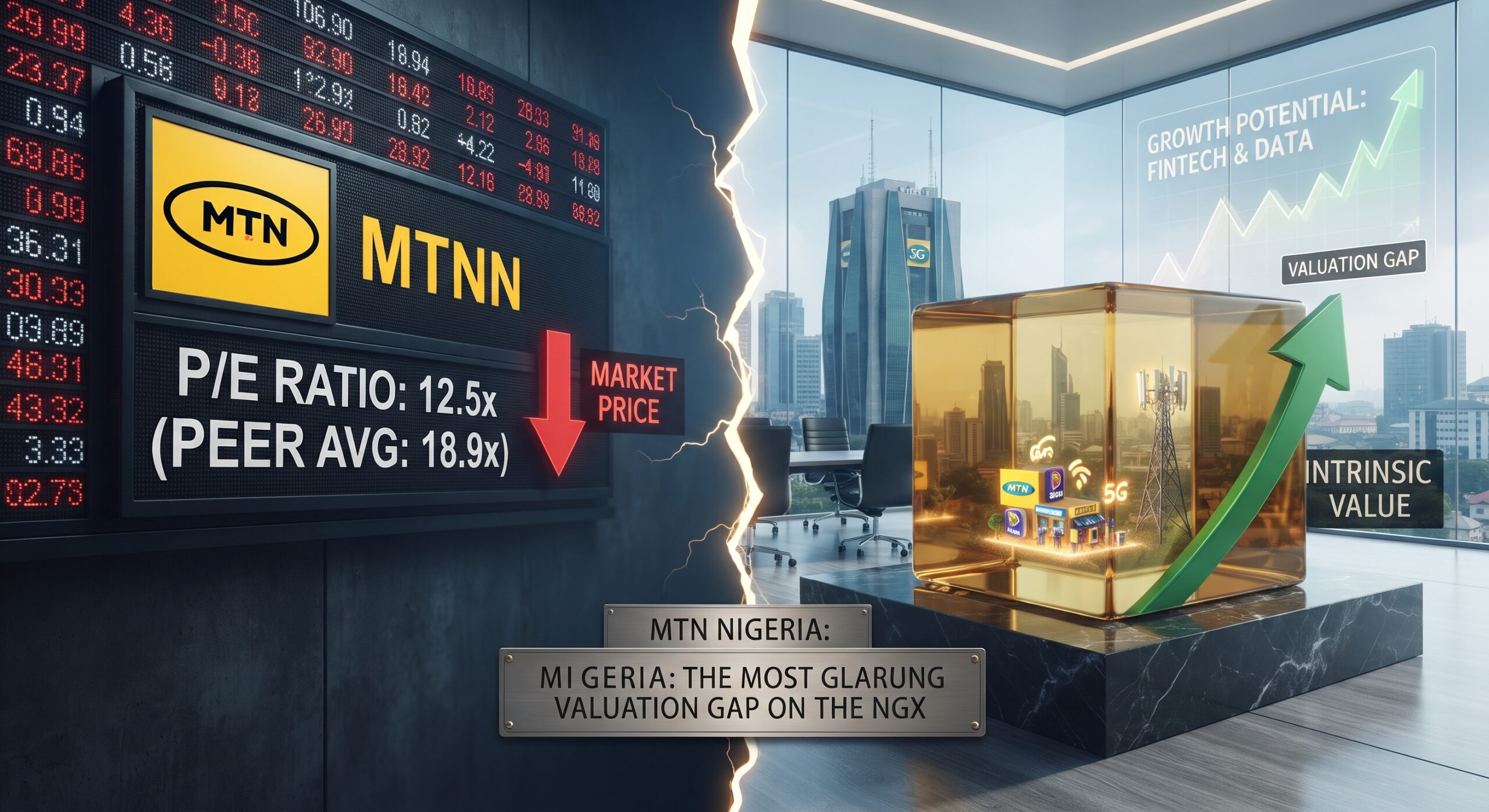
This assertion is not merely boosterism from bullish analysts. It is a conclusion drawn from a rigorous examination of fundamental metrics, comparative analysis with telecommunications peers across emerging markets, and a sober assessment of the company’s future growth vectors, particularly in fintech. The valuation gap, simply defined as the difference between the company’s current market price and its intrinsic value based on future cash flows and growth potential, is the most glaring anomaly on the NGX today.
Understanding why this gap exists, why it persists, and why it is fundamentally unjustified requires a deep dive into the mechanics of Africa’s largest mobile operator and the idiosyncrasies of the Nigerian investment landscape.
The Unrivaled Market Position: A Pillar of the Nigerian Economy
To appreciate the valuation gap, one must first establish the baseline of MTN Nigeria’s dominance. It is not merely a telecommunications company; it is the backbone of Nigeria’s digital economy. With a subscriber base exceeding 77 million as of late 2023, MTN connects a significant portion of Africa’s largest population. Its network infrastructure spans the length and breadth of the country, providing essential voice, data, and increasingly, financial services.
The company’s financial performance has been nothing short of robust. Even in the face of macroeconomic headwinds, including foreign exchange volatility, high inflation, and regulatory shifts, MTN Nigeria has demonstrated remarkable resilience. Its revenue growth remains strong, driven by the insatiable demand for data and the rapid expansion of its fintech ecosystem. The operating margins are the envy of many non-telecom conglomerates, and its free cash flow generation is prodigious.
A company with such a formidable market position, consistent profitability, and strategic indispensability should, by conventional financial logic, trade at a significant premium. Yet, MTN Nigeria consistently trades at a price-to-earnings (P/E) ratio and an enterprise value-to-EBITDA (EV/EBITDA) multiple that suggest it is a mature, slow-growth utility rather than a high-growth digital powerhouse. This is the heart of the valuation gap.
Dissecting the Valuation Gap: Why the Market is Undervaluing MTN
If the fundamentals are so strong, why does the market accord MTN Nigeria such a modest valuation? The reasons are multifaceted, stemming from a combination of regulatory pressures, macroeconomic anxieties, the mispricing of its fintech division, and the structural limitations of the domestic capital market.
1. The Regulatory Burden: A Constant Source of Uncertainty
The single largest factor suppressing MTN Nigeria’s valuation is arguably the regulatory environment in which it operates. The telecommunications sector in Nigeria is overseen by the Nigerian Communications Commission (NCC), and the company also interacts heavily with the Central Bank of Nigeria (CBN) regarding its fintech operations.
Historically, the relationship has been fraught with tension. Massive, multibillion-naira fines and directives, such as the compulsory linkage of Subscriber Identity Modules (SIMs) to National Identification Numbers (NINs) that led to temporary service barring for millions, have instilled a sense of regulatory risk among investors. Every time the NCC or CBN announces a new policy or directive, the market reacts with caution, fearing potential disruptions to revenue or additional costs.
Investors typically demand a risk premium for companies operating in uncertain regulatory environments. This premium manifests in a lower valuation. While MTN Nigeria has successfully navigated these challenges, the perception of heightened regulatory risk remains a persistent anchor on its stock price.
2. Macroeconomic Headwinds: The FX Factor and Inflation
MTN Nigeria does not operate in a vacuum. The Nigerian macroeconomic environment presents significant challenges that impact investor sentiment. The devaluation of the naira against the major global currencies, particularly the US dollar, has been a major headache. Like many multinational corporations operating in Nigeria, MTN incurs substantial foreign currency liabilities, including costs for importing network equipment and payments for international roaming and software licenses.
While its revenue is generated in naira, a significant portion of its capital expenditure and operational expenditure is either dollar-denominated or dollar-linked. This currency mismatch creates volatility in its earnings and exposes the company to foreign exchange losses, which directly impact its bottom line and, by extension, its valuation.
Furthermore, high inflation in Nigeria erodes consumer purchasing power and increases operational costs for the company. While MTN has demonstrated pricing power, there is a limit to how much it can pass these costs on to consumers without impacting demand. These macroeconomic realities contribute to a more cautious outlook from investors, leading to a compressed valuation multiple.
3. The Fintech “Sum of the Parts” Mispricing
Perhaps the most glaring aspect of the valuation gap is the market’s failure to properly value MTN Nigeria’s fintech business, anchored by its MoMo Payment Service Bank (PSB) subsidiary.
Across the globe, telecommunications companies have successfully unlocked immense shareholder value by spinning off or correctly valuing their mobile money and digital financial services divisions. These fintech units typically enjoy much higher growth rates and significantly higher valuation multiples than the core connectivity business.
In the case of MTN Nigeria, the market currently ascribes little to no incremental value to the fintech arm beyond what it contributes directly to the top line in terms of transaction fees. Investors are essentially valuing MTN Nigeria purely as a telco, ignoring the embedded fintech “unicorn.” MoMo is not just a mobile money wallet; it is a rapidly expanding digital bank offering loans, insurance, and advanced merchant payment solutions.
Comparable pure-play fintech companies in emerging markets trade at revenue multiples far exceeding those of traditional telcos. If the market were to apply a more realistic fintech valuation multiple to MoMo and sum it with a fair valuation for the core connectivity business, the resulting share price would be substantially higher than its current level. The continued bundling of the high-growth fintech business within the slower-growth telco structure is a key reason for the valuation gap.
4. The “Conglomerate Discount” on the NGX
Another structural factor at play is the nature of the Nigerian Exchange itself. While the NGX is the largest exchange in West Africa, it lacks the depth, liquidity, and diversity of international bourses like the New York Stock Exchange or the London Stock Exchange. The pool of domestic institutional capital is relatively small, and foreign investment has been constrained by foreign exchange repatriation challenges.
Furthermore, the market tends to apply a “conglomerate discount” to large, complex businesses that dominate the index. Investors often favor simpler, more focused business models. Because MTN Nigeria is so large and its operations so multifaceted, investors may be applying a heuristic that results in an overly simplistic and therefore undervalued assessment of its true worth.
The Case for Correction: Why the Gap Must Close
While the factors above explain why the valuation gap exists, a compelling case can be made for why this anomaly is unsustainable in the long run. The convergence of strategic execution, market maturation, and regulatory evolution points toward a significant re-rating of MTN Nigeria’s stock.
1. The Maturation and Monetization of the Fintech Ecosystem
The most powerful catalyst for closing the valuation gap is the continued scaling and eventual proper recognition of the fintech business. As MoMo PSB gains traction, rolling out advanced credit products, deepening its agent network, and capturing a larger share of the unbanked and underbanked population, its financial contribution will become too significant for the market to ignore.
MTN Nigeria’s management has indicated its strategic intent to unlock value from the fintech unit. Whether through a strategic partnership, a separate listing down the line, or simply by providing more granular financial reporting that allows analysts to construct a sum-of-the-parts valuation, the market will be forced to ascribe a distinct, higher multiple to the fintech segment. This alone could drive a substantial upward re-rating of the entire company.
2. Data Revenue as the New Growth Engine
While voice revenue is maturing, the demand for data is insatiable. MTN Nigeria’s aggressive investment in 4G infrastructure and its nascent 5G rollout positions it perfectly to capitalize on this trend. Data usage per user is growing exponentially, and the company is effectively migrating subscribers from 2G and 3G to 4G, which significantly increases data ARPU (Average Revenue Per User).
Data services typically carry higher margins than voice services. As data becomes the primary revenue contributor, MTN Nigeria’s overall profitability profile will shift, enhancing its attractiveness to growth-oriented investors. The market’s current valuation fails to fully appreciate the long-term revenue and margin accretion from the data business.
3. Stabilization of the Regulatory Environment and Proactive Engagement
The regulatory landscape, while still challenging, is showing signs of stabilization. The initial shock of policies like the NIN-SIM linkage has passed, and the industry is adapting to the new normal. MTN Nigeria’s management has adopted a proactive and constructive approach to engaging with regulators, positioning the company as a partner in national development rather than an adversary.
As regulatory actions become more predictable and the government recognizes the critical role of the telecom sector in its digital economy agenda, the perceived regulatory risk premium should moderate. A more stable regulatory environment will give investors the confidence to apply a higher valuation multiple to the stock.
4. Comparative Peer Analysis: The Evidence is Undeniable
Perhaps the most compelling argument for the valuation gap rests on comparative analysis. When compared to other leading telecommunications operators in similar emerging markets, such as MTN Group (South Africa), Safaricom (Kenya), Airtel Africa, or operators in Southeast Asia, MTN Nigeria consistently trades at a discount on key valuation metrics.
Even accounting for Nigeria’s specific country risk, the magnitude of the discount is difficult to justify based on fundamentals. MTN Nigeria often boasts higher margins, stronger growth prospects, and a larger market share than many of its peers, yet it trades at a lower multiple. This disparity highlights the inefficiency of the market’s current pricing and suggests a significant opportunity for mean reversion.
If MTN Nigeria were to trade merely in line with the average valuation of its emerging market peers, its stock price would see a substantial increase. The fact that it trades at a persistent discount is the very definition of a glaring valuation gap.
The Impact of the Valuation Gap on the NGX
The persistent undervaluation of MTN Nigeria is not just an issue for its shareholders; it has broader implications for the entire Nigerian capital market.
Firstly, it creates a distorted view of the market’s overall health and attractiveness. When the largest and most dominant company on the exchange is perpetually priced at a discount, it sends a negative signal to both domestic and international investors about the market’s ability to correctly price high-growth assets.
Secondly, it hampers MTN Nigeria’s ability to raise capital efficiently. While the company is highly cash-generative, a higher share price would lower its cost of capital, enabling it to fund more ambitious infrastructure projects and acquisitions without diluting existing shareholders excessively. A depressed valuation makes equity financing unattractive, forcing the company to rely more heavily on debt.
Thirdly, it represents a missed opportunity for wealth creation for millions of Nigerian retail investors. Many pension funds and individual investors hold MTN Nigeria directly or through mutual funds. The failure of the market to recognize the company’s true value means these investors are not fully benefiting from the immense value being generated by the company’s operations.
Conclusion: An Opportunity for Value Investors
In conclusion, the premise that MTN Nigeria is the NGX’s most glaring valuation gap is supported by a confluence of evidence. The company’s dominant market position, robust financial performance, and immense growth potential in data and fintech stand in stark contrast to its conservative valuation multiples.
The gap is primarily driven by a combination of perceived regulatory risk, macroeconomic anxieties, the market’s failure to unbundle the fintech value, and structural limitations of the domestic capital market. However, these factors are either temporary, mispriced, or in the process of being resolved.
The maturation of the fintech business, the inexorable rise of data revenue, the stabilization of the regulatory environment, and the undeniable evidence from comparative peer analysis all point to a significant correction. The current valuation is an anomaly, a disconnect between price and value that cannot persist indefinitely.
For the discerning value investor, this situation presents a compelling opportunity. The market is offering a stake in Africa’s leading digital operator at a price that fails to account for its full potential. As the market matures, as the fintech story unfolds, and as the intrinsic value becomes impossible to ignore, the valuation gap will inevitably close, rewarding those who recognized the true worth of MTN Nigeria today. Until then, it remains the most significant and intriguing valuation story on the Nigerian Exchange.