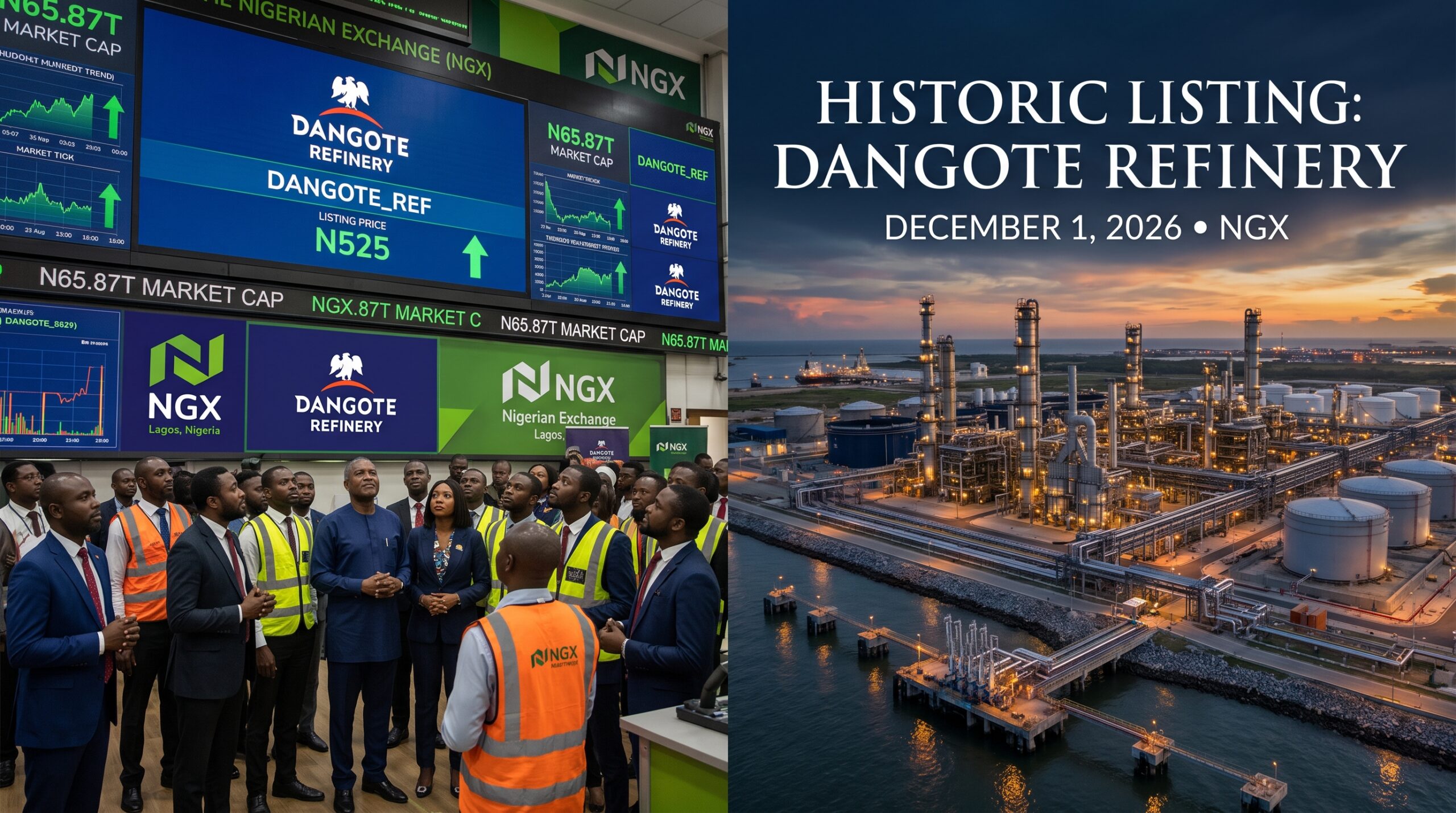
A New Era for African Capital Markets: Dangote Refinery Heads for Historic December 1 Listing on the NGX
On Tuesday, December 1, 2026, the bell at the Nigerian Exchange Limited (NGX) in Lagos will ring in what financial historians, economists, and everyday investors across the continent are already calling a watershed moment. Dangote Petroleum Refinery and Petrochemicals FZE is officially set to list its ordinary shares on the Main Board of the NGX, concluding a record-shattering Initial Public Offering (IPO) that has captivated global markets and democratized access to Africa’s largest industrial enterprise.
For decades, Nigeria’s oil and gas sector operated as an enclave economy. While crude oil generated the lion’s share of the nation’s foreign exchange earnings and government revenue, ordinary citizens had virtually no direct ownership in the refining infrastructure that turned raw crude into usable fuel. Simultaneously, the Nigerian capital market struggled with shallow liquidity, limited retail participation, and a heavy concentration in banking and consumer goods equities. The December 1 listing of Dangote Refinery fundamentally alters both of those realities in a single stroke.
With 125,458,915,901 ordinary shares scheduled to debut at N525 per share, the listing will inject approximately N65.87 trillion (roughly $47 billion) into the market capitalization of the NGX. This debut does not merely represent the largest listing in Nigerian history; it stands as the largest stock market listing ever recorded on the African continent. As final share allotments clear regulatory hurdles and investors await the opening bell, understanding the mechanics, the technology, the economic implications, and the future trajectory of this listing reveals why December 1, 2026, marks a turning point for African finance.
The Anatomy of a Record-Breaking Initial Public Offering
To appreciate the magnitude of the December 1 debut, one must look closely at the numbers behind the IPO that preceded it. Branded by the company as “The IPO for the People,” the public offer opened on September 14, 2026, and closed on October 27, 2026. What transpired during that six-week window shattered every historical benchmark in West African capital markets.
Initially, Dangote Petroleum Refinery offered approximately 4.1 billion ordinary shares to the public, aiming to raise around $1.62 billion. However, investor appetite far outstripped even the most optimistic projections. By the time the offer window closed, total investor orders had surged to nearly $4.5 billion, with applications pouring in for 11.15 billion shares. Confronted with massive oversubscription, the company sought and received approval from the Securities and Exchange Commission (SEC) to exercise a 30 percent over-allotment option, expanding the offering size to 5.33 billion shares and increasing the capital raise to approximately $2.1 billion.
| IPO Metric |
Key Figure / Detail |
| Listing Date |
Tuesday, December 1, 2026 |
| Exchange & Board |
Nigerian Exchange Limited (NGX) Main Board |
| Offer Price per Share |
N525 ($0.39) |
| Total Shares to be Listed |
125,458,915,901 ordinary shares |
| Implied Market Capitalization |
N65.87 trillion (~$47 billion) |
| Total Subscribers |
Approximately 3.8 million investors |
| Geographic Reach |
121 countries (including all 54 African nations) |
| Minimum Subscription |
N5,250 (10 ordinary shares) |
| Post-IPO Ownership Split |
Aliko Dangote (~83.5%), NNPC Ltd (~6.5%), Public (~10%) |
Perhaps the most striking feature of the capital raise was not merely the dollar volume, but the sheer breadth of participation. Approximately 3.8 million individual and institutional subscribers participated in the offer, spanning 121 countries worldwide. Crucially, applications were recorded from every single one of Africa’s 54 nations, turning a Nigerian corporate milestone into a genuinely pan-African financial event.
Following the SEC’s formal approval of the share allotment plan in late November 2026, details emerged regarding how this oversubscribed pie would be divided. In keeping with the ethos of broad-based wealth creation, the allotment structure was designed to prioritize everyday citizens and domestic institutions. Retail investors are slated to receive full allocations for their applications, while local pension funds will receive allocations very close to their total subscription amounts. Foreign institutional investors, who submitted substantial bids, will absorb the bulk of the scale-backs.
Upon listing, founder Aliko Dangote will retain approximately 83.5 percent ownership of the enterprise, maintaining strategic control, while the Nigerian National Petroleum Company Limited (NNPC Ltd) will hold roughly 6.5 percent, leaving the remaining equity in the hands of the newly minted public shareholders.
How Digital Rails Unlocked Mass Retail Participation
For years, a persistent criticism of the Nigerian stock market was its accessibility barrier. Traditional IPOs required physical forms, visits to bank branches, cumbersome Know Your Customer (KYC) paperwork, and high minimum investment thresholds that effectively locked out salaried workers, students, artisans, and market traders. The Dangote Refinery IPO dismantled these barriers through a combination of deliberate pricing and cutting-edge financial technology.
First, setting the minimum subscription at just 10 ordinary shares for N5,250 ensured that virtually anyone with modest savings could acquire a stake in the refinery. By pricing the entry point below the cost of a standard tank of fuel or a bag of groceries, the offer transformed passive consumers of petroleum products into equity owners.
Second, the technical backbone of the capital raise was powered by NGX Invest, the SEC-approved digital capital-raising platform launched by the Nigerian Exchange Group in June 2024. Instead of relying solely on traditional stockbroking houses, NGX Invest integrated a sprawling network of 186 distribution channels. Investors were able to subscribe seamlessly through commercial banking apps, leading fintech platforms, licensed stockbrokers, and even automated WhatsApp workflows.
“The listing of Dangote Petroleum Refinery will mark an important milestone for Nigeria’s capital market, demonstrating its capacity to support large-scale industrial enterprises and mobilize long-term capital. The breadth of investor participation in the public offer also reflects the progress we have made in expanding market access. Through technology, strategic partnerships and a diverse distribution network, we are connecting more people to investment opportunities and more businesses to capital.”
— Temi Popoola, Group Managing Director and CEO, NGX Group
This friction-free digital onboarding proved decisive. Millions of first-time investors opened Central Securities Clearing System (CSCS) accounts digitally, linked their Bank Verification Numbers (BVN) and Clearing House Numbers (CHN), and completed their purchases in minutes. As registrars finalize the verification checks and credit allotted shares directly into investors’ CSCS accounts ahead of December 1, Nigeria’s active retail investor base has expanded dramatically. The long-term dividend for the NGX is that millions of citizens now possess active brokerage accounts and digital investment habits that will likely spill over into other listed equities, bonds, and exchange-traded funds.
Financing the Next Leap: Doubling Capacity to 1.4 Million Barrels Per Day
Unlike some IPOs where proceeds are used strictly to allow early private equity backers to cash out, the Dangote Refinery public offer is squarely focused on aggressive industrial expansion. According to the company’s prospectus, the net proceeds from the IPO will directly support an ambitious $14.3 billion expansion program aimed at doubling the facility’s refining capacity from its current 700,000 barrels per day (bpd) to approximately 1.4 million bpd.
To understand the scale of this ambition, it helps to examine what the Lekki Free Zone facility has already achieved. Built as the world’s largest single-train refinery, the plant began operations after years of complex engineering and multi-billion-dollar debt financing. Throughout 2026, the refinery has steadily ramped up its operational throughput, overcoming initial crude supply logistics and regulatory friction. By November 2026, product loadings from the refinery hit a record 575,000 barrels per day, proving that the massive complex can operate reliably near nameplate capacity while supplying petrol, diesel, aviation fuel, and petrochemicals to both the domestic Nigerian market and international export destinations.
Expanding capacity to 1.4 million barrels per day will place the Lekki complex among the absolute largest refining hubs anywhere on earth, rivaling or surpassing massive complexes in Jamnagar, India, and Ulsan, South Korea. The expansion is expected to unfold over the next two and a half years, adding new processing units, expanding petrochemical output (such as polypropylene and fertilizers), and further solidifying West Africa’s transition from a net importer of refined petroleum products into a major global exporter.
Furthermore, Aliko Dangote has already signaled that the NGX listing is the first phase of a broader global capital markets strategy. Speaking in September 2026, the industrialist revealed plans to pursue a secondary listing on a major United States stock exchange once the 1.4 million bpd expansion is completed within the next 30 months. By proving operational cash flows on the NGX first, the refinery aims to command a premier global valuation when it eventually taps Wall Street capital.
Transforming the Nigerian Exchange and Macroeconomic Landscape
The arrival of a N65.87 trillion company on the NGX Main Board fundamentally reshapes the structure of the Nigerian equities market. Prior to this listing, the entire market capitalization of the NGX hovered around the N55 trillion to N60 trillion mark, dominated by heavyweights like Dangote Cement, MTN Nigeria, Airtel Africa, BUA Foods, and tier-one commercial banks.
Adding Dangote Petroleum Refinery essentially doubles the total valuation of the exchange overnight. This massive expansion carries several profound consequences for institutional investors, index trackers, and the broader Nigerian economy:
-
Global Index Re-Weighting: Frontier and emerging market index providers, such as MSCI and FTSE Russell, rely heavily on market capitalization and free-float liquidity when determining country weights. A $47 billion industrial titan trading in Lagos forces global fund managers to re-evaluate Nigeria’s weighting in pan-African and frontier market portfolios, potentially attracting renewed foreign portfolio inflows.
-
Portfolio Diversification for Domestic Pension Funds: Nigeria’s Pension Fund Administrators (PFAs) manage trillions of naira in retirement assets, yet they have historically faced a shortage of large, liquid, inflation-hedged domestic assets outside of government treasury bills and a handful of blue-chip stocks. Dangote Refinery provides PFAs with a direct, dollar-linked industrial asset capable of generating long-term dividends and capital appreciation.
-
Naira Stability and Foreign Exchange Conservation: For decades, fuel importation consumed up to 30 to 40 percent of Nigeria’s foreign exchange reserves, creating chronic pressure on the naira. As the refinery scales toward 1.4 million bpd, it not only eliminates the need for imported refined fuels but also generates substantial hard currency revenues from exports of refined products and petrochemicals across West Africa, Europe, and the Americas.
-
Corporate Governance and Transparency: Transitioning from a private free-zone enterprise into a publicly traded Main Board company subjects Dangote Refinery to strict quarterly financial reporting, independent audit disclosures, and continuous market scrutiny. For international lenders, off-takers, and institutional investors, this heightened transparency lowers perceived sovereign and corporate risk.
Weighing the Valuation: Optimism vs. Analyst Caution
Despite the euphoria surrounding the oversubscription and the historic nature of the debut, seasoned market analysts and institutional fund managers are approaching the December 1 opening bell with a blend of excitement and disciplined scrutiny.
At N525 per share, the implied valuation of roughly $47 billion places Dangote Refinery in an elite tier of global energy companies. For comparison, established global independent refiners with decades of operating history and multi-continent asset bases often trade at significant discounts to replacement cost due to the cyclical nature of refining margins.
Analysts monitoring the listing have highlighted several key variables that will dictate share price performance once open market trading begins:
-
Refining Margins (Crack Spreads): Refining is inherently a margin business. Profitability depends on the spread between the cost of crude oil feedstock and the selling price of refined outputs like gasoline, diesel, and jet fuel. Global refining margins fluctuate based on OPEC+ production decisions, global economic growth, and seasonal demand shifts. Investors will closely watch how effectively the refinery manages crude sourcing costs, particularly regarding naira-denominated crude supply agreements with NNPC Ltd versus international crude purchases.
-
Debt Service and Capital Expenditure: Building a 700,000 bpd greenfield refinery required monumental capital expenditure, leaving the company with substantial debt obligations on its balance sheet. Simultaneously, embarking on a $14.3 billion expansion program means capital expenditures will remain elevated over the next three years. Analysts will scrutinize the company’s free cash flow generation and its timeline for deleveraging while funding growth.
-
Post-Listing Liquidity and Price Discovery: Because retail investors received full allocations and institutional demand was heavily scaled back during the IPO, the opening days of trading on the NGX could see intense buying pressure from institutions looking to build full positions. Conversely, some retail investors looking for quick short-term profits may sell into early rallies. How the stock absorbs this initial supply-and-demand tug-of-war will establish its true market equilibrium.
Some market observers have questioned whether the $47 billion valuation already prices in a substantial amount of future growth and operational perfection. Yet supporters counter that valuations cannot be viewed solely through traditional Western refining multiples. Dangote Refinery enjoys a near-monopolistic logistical advantage in a rapidly growing continent of over 1.4 billion people, where per-capita energy consumption is poised to rise steadily for decades. Coupled with its integrated petrochemical complex, the facility commands structural advantages that few global peers can replicate.
What Investors Should Expect on December 1 and Beyond
As the countdown to Tuesday, December 1, 2026, enters its final hours, operational preparations across Lagos are in full swing. Registrars have been working around the clock to verify subscriber data, reconcile bank details, and ensure that allotted shares are seamlessly credited to investors’ CSCS accounts before the market opens. Meanwhile, the company has issued repeated public advisories warning subscribers against fraudsters, reminding the public that the offer closed on October 27 and that genuine share allocations occur strictly through official registrars and regulated capital market operators.
When trading officially commences on the floor of the NGX, all eyes will be glued to the ticker. Under NGX trading rules, newly listed equities are subject to daily price movement limits (typically capped at 10 percent upward or downward per session), meaning any sustained institutional demand could trigger consecutive days of upper-limit price appreciation before equilibrium is reached.
Beyond the immediate excitement of opening-day price action, the true significance of December 1 lies in what it represents for African self-reliance and financial architecture. For generations, the narrative surrounding African infrastructure was one of external dependency: foreign contractors built the assets, foreign banks financed them, and foreign shareholders collected the dividends.
The listing of Dangote Petroleum Refinery rewrites that script. Conceived and built on Nigerian soil, financed largely through African capital markets, distributed via homegrown fintech rails, and now owned by 3.8 million citizens across all 54 African nations, the refinery stands as proof that the continent possesses both the industrial ambition and the domestic capital pool to fund its own transformation.
Whether the stock surges immediately on Tuesday morning or consolidates as the market digests its historic scale, one fact is already beyond dispute. On December 1, 2026, the Nigerian Exchange will not just welcome a new ticker symbol; it will step into a new era of scale, inclusivity, and global relevance. For the millions of everyday investors checking their brokerage apps from Lagos to Nairobi, Accra to Johannesburg, owning a piece of Africa’s industrial future is no longer an aspiration. It is a reality.