Across the fertile riverbanks of Kogi State, where the Niger and Benue rivers converge, agriculture is far more than a seasonal occupation. It is the backbone of household survival, rural employment, and regional food supply for central and southern Nigeria. Yet every rainy season brings an existential gamble for communities along the floodplains. When rising waters breach riverbanks and spill across low-lying farmlands, months of labor and millions of naira in capital can vanish beneath murky currents within hours.
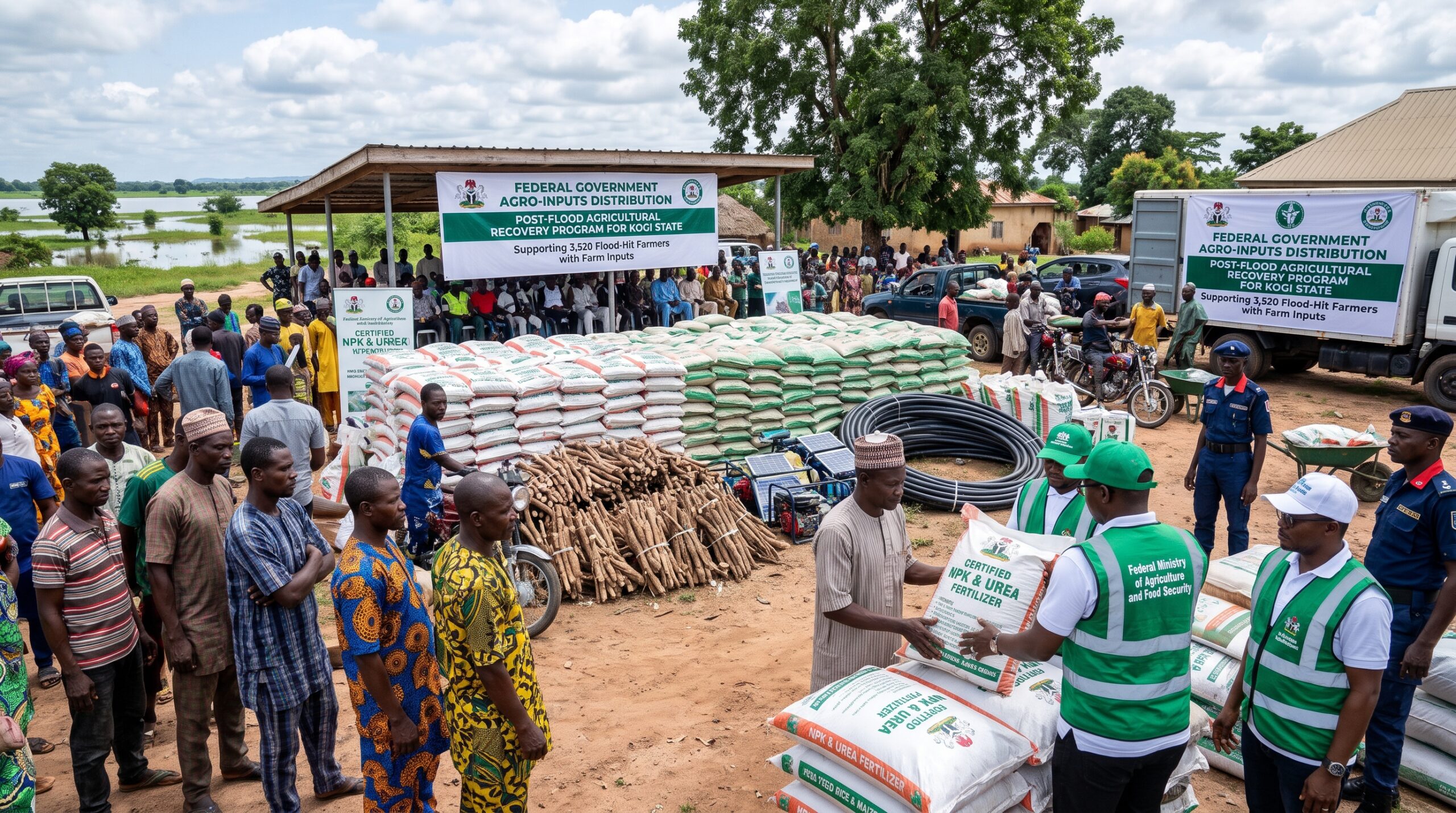
In a decisive move to cushion the impact of recent flood devastation and safeguard upcoming harvest cycles, the Federal Government of Nigeria has rolled out a targeted agricultural recovery intervention benefiting 3,520 flood-affected smallholder farmers across Kogi State. Delivered through the Federal Ministry of Agriculture and Food Security (FMAFS) in collaboration with the Kogi State Government and local agricultural development agencies, the program distributes essential farm inputs designed to get displaced and distressed growers back onto their fields immediately.
For a state widely recognized as one of Nigeria’s critical food baskets for cassava, rice, yam, maize, and sorghum, timely input support is the difference between a rapid rebound and a prolonged food deficit. Understanding the full scope of this intervention requires looking closely at what the 3,520 beneficiaries are receiving, why Kogi State remains uniquely vulnerable to annual flooding, how the distribution framework ensures accountability, and what additional measures are required to build long-term climate resilience across Nigeria’s agrarian communities.
Inside the Federal Government’s Input Distribution Package
When floodwaters recede from agrarian communities, farmers rarely have the liquid cash reserves needed to purchase fresh planting materials, soil nutrients, or crop protection chemicals. Most smallholder growers invest their entire seasonal capital into land preparation, seedlings, and fertilizer before the rains peak. Losing a crop right before harvest strips away both household food reserves and the working capital needed for the next planting cycle.
To break this cycle of post-disaster insolvency, the Federal Ministry of Agriculture and Food Security structured the Kogi intervention around high-yield, fast-maturing, and climate-smart agricultural inputs tailored specifically for dry-season and residual-moisture farming.
Key components of the farm input package distributed to the 3,520 Kogi farmers include:
-
Improved, Flood-Tolerant and Early-Maturing Seeds: Beneficiaries received certified high-yielding rice seeds, drought- and flood-resilient maize varieties, and improved cassava stems capable of maturing within compressed planting windows so farmers can recover lost output before the next rainy season begins.
-
Organic and Inorganic Fertilizers: Because severe flooding washes away topsoil nutrients and leaves behind leached, sandy silt, the package includes NPK and urea fertilizers alongside organic soil conditioners to restore soil fertility rapidly.
-
Crop Protection Agrochemicals: Post-flood environments often trigger sudden outbreaks of pests, fungal infections, and aggressive weeds. Farmers were supplied with targeted herbicides, insecticides, and fungicides to protect emerging shoots during vulnerable early growth stages.
-
Dry-Season Irrigation Equipment: Recognizing that post-flood recovery relies heavily on dry-season cultivation between November and April, select farmer clusters received solar-powered and fuel-efficient water pumps, hoses, and drip kits to draw water from receding river channels and fadama plains.
-
Growth Enhancers and Post-Harvest Storage Bags: Hermetic storage sacks and foliar micronutrients were included to maximize grain fill and prevent post-harvest insect losses once crops are harvested.
By distributing physical inputs rather than cash grants alone, the ministry aimed to prevent the diversion of relief funds toward non-agricultural expenses while ensuring that farmers received certified, unadulterated seeds and agrochemicals directly suited to Kogi’s ecological zones.
Why Kogi State Sits at the Frontline of Nigeria’s Flood Crisis
To appreciate why Kogi State consistently requires rapid federal agricultural interventions, one must look at its unique geography. Located at the confluence of the Niger and Benue rivers, Kogi acts as the hydrological funnel of Nigeria. Whenever heavy rainfall occurs in the upper catchments of West Africa, or when upstream dams release excess water to protect structural integrity, the combined volume passes directly through Kogi’s riverine local government areas before draining toward the Niger Delta.
Nine local government areas in Kogi State bear the brunt of annual riverine inundation:
-
Ibaji Local Government Area: Often completely submerged during peak flood seasons, Ibaji is one of Nigeria’s premier rice-producing zones, where flat alluvial plains leave communities with almost no natural elevation buffer.
-
Lokoja Local Government Area: Sitting directly at the confluence, farmlands along the Ganaja, Adankolo, and Sarkin Noma corridors routinely suffer devastating washouts of rice, maize, and vegetable farms.
-
Koton Karfe (Kogi Local Government Area): Low-lying agricultural settlements along the Niger axis regularly experience crop losses and displacement of farming households.
-
Idah and Igalamela-Odolu Local Government Areas: Major hubs for yam, cassava, and palm oil production where seasonal surges inundate riverside plantations and rural access roads.
-
Ofu, Ajaokuta, Bassa, and Omala Local Government Areas: Communities bordering both the Niger and Benue rivers rely heavily on fadama rice cultivation and dry-season vegetable farming, making them acutely exposed to sudden water level spikes.
| Agricultural Value Chain in Kogi State |
Primary Flood-Prone Producing LGAs |
Typical Flood Damage Impact |
Recovery Strategy via FG Input Support |
| Lowland & Fadama Rice |
Ibaji, Lokoja, Koton Karfe, Bassa |
Total submergence of paddy fields prior to harvest; siltation of irrigation canals |
Distribution of early-maturing lowland rice varieties and water pumps for dry-season cropping |
| Cassava & Yam Tubers |
Idah, Igalamela-Odolu, Ofu, Omala |
Root rot caused by prolonged waterlogging; loss of stored seed yams |
Supply of disease-resistant cassava stems and soil-rejuvenating fertilizers |
| Maize & Sorghum |
Lokoja, Ajaokuta, Koton Karfe, Bassa |
Lodging of stalks, grain mold, and complete washout of riverine farms |
Provision of certified hybrid maize seeds and crop protection chemicals |
| Horticulture & Vegetables |
Lokoja, Ajaokuta, Idah |
Destruction of tomato, pepper, and okra nurseries along riverbanks |
Dry-season irrigation kits, organic inputs, and fast-cycling vegetable seeds |
When floods strike these nine local government areas, the shockwaves extend far beyond Kogi’s borders. Lokoja serves as a primary transit and aggregation hub linking northern agricultural corridors with markets in Abuja, Onitsha, Lagos, and Ibadan. A sharp drop in Kogi’s rice, yam, and cassava output immediately tightens regional supply and pushes up food prices across neighboring states.
Targeting, Verification, and Accountability in the Rollout
One of the most persistent criticisms of historical agricultural relief programs in Nigeria has been the diversion of subsidized or free inputs to political middlemen and open-market speculators, leaving genuine farmers empty-handed. To ensure the 3,520 beneficiaries in Kogi State were authentic flood victims actively engaged in farming, the Federal Ministry of Agriculture and Food Security enforced a multi-layered verification protocol.
The selection and distribution process relied on four institutional safeguards:
-
Joint Flood Impact Assessment: Field officers from the Federal Ministry of Agriculture, the Kogi State Ministry of Agriculture and Food Security, the Kogi Agricultural Development Project (ADP), and the National Emergency Management Agency (NEMA) conducted physical farm inspections and satellite-assisted flood mapping to identify genuinely inundated farmlands.
-
Cooperative and Commodity Association Validation: Rather than relying on arbitrary individual lists, beneficiaries were verified through registered smallholder cooperatives, All Farmers Association of Nigeria (AFAN) state chapters, and commodity-specific groups such as the Rice Farmers Association of Nigeria (RIFAN).
-
Biometric and NIN-Linked Registration: Each of the 3,520 farmers was captured on a digital register linked to their National Identification Number (NIN), phone contact, farm coordinates, and specific crop loss profile, preventing duplicate allocations.
-
Transparent Public Flag-Off and Cluster Handover: Distributions were conducted transparently at designated agricultural zonal centers in the presence of traditional rulers, community leaders, anti-corruption observers, and extension agents, with clear warnings that any individual caught reselling free government inputs would face prosecution.
By anchoring distribution in verified farm data and local cooperative structures, authorities sought to guarantee that every bag of fertilizer, liter of herbicide, and sachet of certified seed landed directly in the hands of a grower preparing to replant.
Connecting Kogi’s Relief Effort to National Food Security Goals
The support extended to 3,520 Kogi farmers does not exist in isolation. It forms an integral pillar of the Federal Government’s broader Emergency Food Security Response and the National Agricultural Growth Scheme and Agro-Pocket (NAGS-AP) framework. Over the past two years, rising food inflation, elevated transportation costs, and climate shocks have placed immense pressure on Nigerian households, making domestic agricultural productivity a top national security priority.
Under the dry-season farming expansion strategy spearheaded by the Federal Ministry of Agriculture and Food Security, flood-affected states are treated as priority zones for rapid agricultural recovery. The logic is straightforward: Nigeria cannot afford to lose an entire year of harvest from its central riverine belt when dry-season cultivation offers an immediate second window to produce food.
With access to residual soil moisture left behind by receding floodwaters, alongside newly distributed water pumps and short-duration seeds, Kogi farmers can plant between November and December and harvest by March or April. This turnaround injects fresh supplies of paddy rice, maize, and vegetables into domestic markets during the lean season when food prices typically peak.
Furthermore, supporting smallholder farmers to remain productive prevents rural-to-urban distress migration. When flood victims receive tangible tools to rebuild their livelihoods in their home communities, rural economies remain vibrant, local grain mills stay active, and youth employment in farming and agro-processing is preserved.
Voices from the Field: How Input Support Changes the Calculus for Smallholders
For a smallholder farmer cultivating two hectares of rice in Ibaji or maize along the banks of Koton Karfe, the financial arithmetic of a flood disaster is brutal. Preparing land, purchasing seeds, hiring labor for weeding, and applying fertilizer can easily cost between ₦350,000 and ₦600,000 per hectare depending on input prices. When a sudden surge in the River Niger wipes out that crop weeks before harvest, the farmer is left with zero revenue and often unpaid informal debts to local input dealers.
Receiving a complete recovery kit from the Federal Government changes that equation in three immediate ways:
-
Eliminating Upfront Input Capital Barriers: Seeds and fertilizers typically account for more than 50 percent of a smallholder’s variable production cost. Getting certified inputs free of charge allows farmers to channel whatever modest savings or family labor they have left directly into land clearing and planting.
-
Boosting Yield Per Hectare: Many rural farmers rely on saved grains from previous harvests rather than certified improved seeds, which depresses their yields. Introducing high-yielding, disease-resistant seeds alongside balanced fertilizers enables beneficiaries to achieve significantly higher tonnage per hectare than they did prior to the flood.
-
Encouraging Adoption of Modern Agronomic Practices: Alongside physical input handovers, state agricultural extension officers provide hands-on guidance on proper spacing, micro-dosing of fertilizers, safe agrochemical application, and water management. This technical advisory helps farmers maximize every input provided.
Beyond Emergency Relief: Building Long-Term Flood Resilience in Kogi
While the distribution of farm inputs to 3,520 flood-hit farmers provides vital immediate relief, agricultural economists, hydrologists, and farmer associations agree that emergency handouts alone cannot solve Kogi State’s recurring flood challenge. Every year that riverine communities rebuild without structural protection leaves them vulnerable to the next rainy season.
To transition Kogi agriculture from perpetual disaster recovery to sustainable growth, stakeholders point to five structural priorities that must accompany input distribution:
1. Expanding Agricultural Insurance Coverage
Currently, only a small fraction of smallholder farmers in Kogi State hold weather-index or yield-based agricultural insurance. Integrating automatic Nigerian Agricultural Insurance Corporation (NAIC) or private micro-insurance coverage into every federal and state input program ensures that when floods destroy insured crops, farmers receive prompt financial payouts without waiting months for emergency relief allocations.
2. Investing in Water Harvesting, Embankments, and Dredging
Managing the confluence of the Niger and Benue rivers requires sustained engineering investments. Constructing strategic retention dams, reinforcing community dykes, desilting blocked tributaries, and building flood-protected irrigation canals can transform destructive seasonal floodwaters into controlled reservoirs for year-round irrigation.
3. Strengthening Early Warning Systems and Planting Calendar Adjustments
Meteorological agencies such as the Nigerian Meteorological Agency (NiMet) and the Nigeria Hydrological Services Agency (NIHSA) issue annual seasonal climate predictions and flood outlooks. Translating those technical forecasts into clear, local-language advisories delivered via rural radio and extension workers allows Kogi farmers to plant earlier, adopt ultra-short-duration varieties, and harvest before river levels peak in August and September.
4. Developing Upland Commercial Farming Corridors
Kogi State possesses vast expanses of arable upland terrain across Kogi Central, Kogi West, and parts of Kogi East that sit well above riverine floodplains. Opening up upland farm estates with mechanized land clearing, feeder roads, and solar boreholes can diversify production away from high-risk flood zones.
5. Expanding Post-Harvest Aggregation and Agro-Processing
Building flood-proof community silos, rice parboiling centers, and cassava processing hubs on elevated ground protects harvested produce from water damage and enables farmers to store crops safely until market prices stabilize.
Looking Ahead for Kogi’s Farming Communities
The Federal Government’s delivery of farm inputs to 3,520 flood-affected farmers in Kogi State represents a timely and practical investment in both rural livelihoods and national food security. By equipping resilient smallholder growers with improved seeds, fertilizers, agrochemicals, and dry-season irrigation tools, the intervention turns receding floodwaters into an opportunity for rapid agricultural recovery.
As beneficiaries return to their farms across Ibaji, Lokoja, Koton Karfe, Idah, and neighboring local government areas, sustained follow-up by agricultural extension officers and transparent monitoring of dry-season harvests will be essential to ensure the program achieves its full potential. Combined with stronger water infrastructure, wider crop insurance, and climate-smart farming practices, targeted support like this lays the groundwork for a more secure and productive future for Kogi State’s farmers and the millions of Nigerians who depend on their harvests every day.