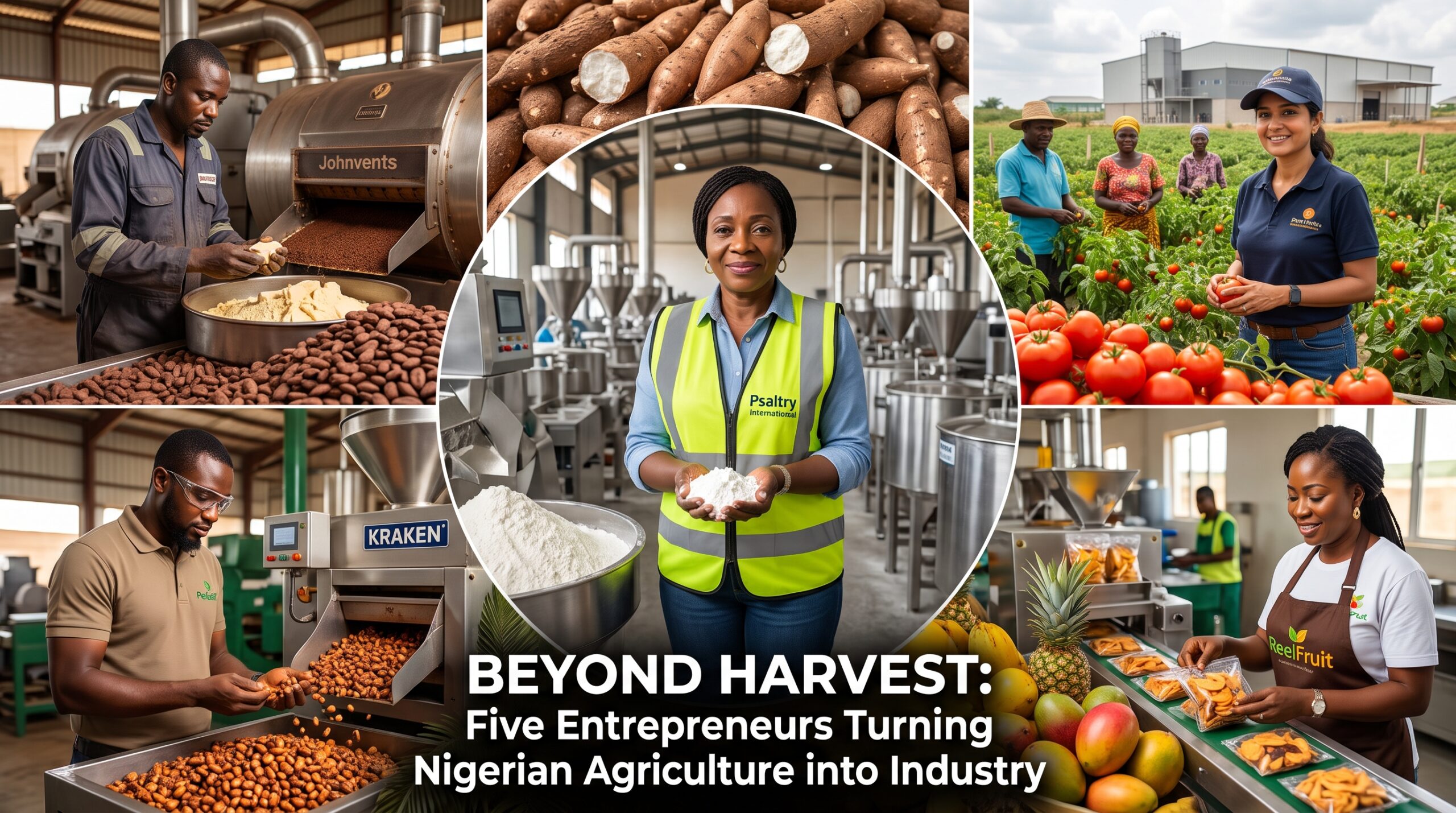
For generations, the story of Nigerian agriculture has been told through the prism of the harvest. It is an annual spectacle of abundance: busy market days, trucks loaded with raw produce, and roadside stalls overflowing with seasonal crops like cassava, tomatoes, and cocoa. Nigeria has never had a problem with growing things. The country is the world’s largest producer of cassava, Africa’s top producer of diverse staple crops, and a global force in cocoa.
Yet, for too long, this spectacular bounty has been undermined by a painful economic reality: the failure to look beyond the harvest. Every year, millions of tons of raw agricultural produce rot in transit, in under-equipped storage facilities, or on the fields themselves because of post-harvest losses. Meanwhile, the country has spent billions of dollars annually importing processed food, industrial raw materials, and finished goods that could easily be manufactured at home. Raw commodities are exported for a fraction of their potential worth, only to be re-imported as high-value consumer goods.
Over the past few years, a quiet but profound industrial shift has begun to reverse this trend. A new generation of visionary “agripreneurs” is moving Nigeria from a nation of raw farmers to a powerhouse of industrial processors. Understanding that the real wealth of a nation’s soil is captured after the harvest, these innovators are building processing plants, applying cutting-edge logistics, and manufacturing industrial inputs that replace expensive imports.
1. Yemisi Iranloye: The Cassava Champion Transforming Tubers into Industrial Ingredients
Nigeria is the undisputed global heavyweight in cassava production, cultivating over 60 million metric tons of the starchy tuber annually. Yet historically, this crop has been treated almost entirely as a subsistence staple, consumed locally as garri, fufu, or lafun. The challenge with cassava is its highly volatile shelf life: once harvested, the tubers begin to deteriorate within 24 to 48 hours, making transportation over long distances an logistical nightmare.
Yemisi Iranloye, the founder and Managing Director of Psaltry International, saw this perishability not as a barrier, but as an industrial opportunity. Established in 2005 in Oyo State, Psaltry International has pioneered the commercial-scale processing of cassava into high-grade industrial ingredients, including food-grade starch, high-quality cassava flour (HQCF), glucose, and, most notably, sorbitol.
Sorbitol is a versatile industrial sweetener and humectant used extensively in toothpastes, pharmaceuticals, cosmetics, and confectionery. Before Psaltry’s breakthrough, Nigeria and indeed most of Africa imported 100 percent of their sorbitol requirements, largely from India and China. In 2022, Psaltry commissioned Africa’s first-ever cassava-based sorbitol factory, a state-of-the-art facility capable of processing hundreds of tons of cassava daily.
Key aspects of Psaltry’s industrial model include:
-
Outgrower Network Security: To guarantee a continuous supply of fresh tubers to its Oyo factory, Psaltry does not rely solely on its own plantations. It has built an outgrower network of over 10,000 smallholder farmers, providing them with high-yield stems, fertilizers, and extension training, while guaranteeing a predictable buy-back price.
-
Import Substitution: By refining cassava into premium, food-grade starch and sorbitol, Psaltry supplies massive multinational fast-moving consumer goods (FMCG) brands operating in Nigeria, including Unilever, Nestlé, and Nigerian Breweries, directly reducing their dependence on foreign exchange for raw materials.
-
Locational Advantage: Psaltry strategically situated its processing plant directly in the rural farming clusters of Oyo State. This minimizes transit times, ensures the cassava is processed at peak freshness, and keeps industrial wealth and jobs within the rural economy.
Through Psaltry International, Iranloye has demonstrated that cassava is not just a subsistence food, but a high-value industrial input capable of powering modern manufacturing.
2. John Alamu: Keeping More Value in Nigeria’s Cocoa Chain
Cocoa has been a cornerstone of Nigeria’s export economy since before independence. However, the trade has historically followed a predictable colonial-era pattern: smallholder farmers in the southwest harvest the pods, dry the beans, and sell them to buying agents, who then export the raw commodities to Europe and Asia. The value-added processing—transforming raw beans into cocoa butter, cocoa liquor, cake, and powder—happens overseas, with the finished chocolates and beverages sold back to African consumers at premium prices.
John Alamu, the Founder and Group Managing Director of Johnvents Group, is on a mission to rewrite this narrative by driving local, industrial cocoa processing. Founded with a vision to retain the economic benefits of agriculture within Nigeria, Johnvents Group has rapidly grown to operate one of the largest and most advanced cocoa processing factories in West Africa.
In 2021, Johnvents acquired the defunct 15,000-metric-ton cocoa processing factory in Akure, Ondo State. Within a short period, Alamu’s team rehabilitated and expanded the facility into a 27,000-metric-ton industrial giant. Today, rather than exporting only raw, unprocessed beans, Johnvents processes cocoa into industrial-grade intermediate products:
-
Natural Cocoa Butter: Sold to global chocolate manufacturers and cosmetic brands.
-
Natural and Alkalized Cocoa Powder: Used extensively by local and international beverage, baking, and confectionery industries.
-
Natural Cocoa Liquor and Cake: Essential base ingredients for various food processing chains.
Alamu’s approach relies on bridging the gap between smallholder sourcing and international industrial standards. By maintaining relationships with more than 40,000 farmers and securing international certifications (including UTZ and Rainforest Alliance), Johnvents ensures that its processed outputs are competitive on the global stage.
Under Alamu’s leadership, the company has expanded its footprint to multiple factories and operations across 19 countries, demonstrating that with the right combination of capital, engineering, and supply-chain oversight, Nigerian agro-industrial brands can compete with global commodities giants while keeping the processing margins—and thousands of jobs—firmly at home.
3. Mira Mehta: Building a Market for Nigerian Tomatoes
If you travel through the northern agricultural belts of Kano, Kaduna, and Gombe during the harvest season, you will encounter a bittersweet sight: vast fields of bright red, ripe tomatoes, juxtaposed with roadside heaps of rotting fruit. Nigeria is one of Africa’s largest producers of tomatoes, yet it faces an estimated post-harvest loss rate of 40 to 50 percent due to a lack of cold-chain logistics, poor roads, and a severe deficit in local processing capacity. At the same time, Nigeria has historically imported huge quantities of tomato paste, largely from China, to meet the daily culinary demands of its 200 million people.
Mira Mehta, an entrepreneur who first encountered this paradox while working in public health in northern Nigeria, decided to tackle the problem head-on. In 2015, she founded Tomato Jos, an agro-processing company dedicated to bridging the gap between local farming and industrial paste production.
Located in Kaduna State, Tomato Jos began as a farming and educational venture, working patiently with local smallholders to raise their yields from a meager 5 metric tons per hectare to over 40 metric tons through modern irrigation, improved seed varieties, and disciplined agronomy. The ultimate goal, however, was always industrial.
In 2021, Tomato Jos took its biggest leap by commissioning an multi-million-dollar tomato processing plant. The facility:
-
Reduces Wastage: It provides a reliable, high-capacity market for hundreds of local outgrower farmers, ensuring their surplus harvests are processed immediately.
-
Solves the Sourcing Crisis: Processing tomatoes is notoriously difficult because a factory requires hundreds of tons of raw, consistent fruit daily to remain commercially viable. By combining its own commercial farm with its outgrower network, Tomato Jos solved the sourcing puzzle that had crashed previous large-scale processing ventures in the region.
-
Packages for the Consumer: The factory not only processes raw tomatoes into paste but also packages it into retail-ready sachets and tins, directly competing with imported brands on grocery shelves.
By integrating the entire value chain from seed to sachet, Mehta has shown that solving Nigeria’s post-harvest crisis requires a patient, industrial-grade solution that treats farmers as partners in a manufacturing enterprise.
4. Ikenna Nzewi: Applying Technology to the Palm-Oil Value Chain
To understand the trajectory of Nigeria’s palm oil industry, one must look back to the 1960s, when Nigeria was the world’s leading exporter of the commodity. Over the subsequent decades, Nigeria lost its dominance to Southeast Asian nations like Malaysia and Indonesia, which industrialized their production. Today, while Nigeria still has millions of wild and cultivated oil palm trees, the industry is dominated by fragmented, small-scale processors using manually intensive, inefficient methods that leave significant oil behind in the fruit.
Ikenna Nzewi, the co-founder and CEO of Releaf, represents the technological vanguard of Nigerian agro-industrialization. Founded in 2017, Releaf took an unconventional, data-driven approach to agriculture: instead of trying to own vast plantations, the company focuses on optimizing the mid-stream processing and logistics of the oil palm value chain.
The core challenge in the informal palm-kernel market is extracting the kernel from its hard, outer shell efficiently and without damage. Hand-cracking is slow and laborious, while traditional mechanical crushers often damage the kernels, leading to higher levels of free fatty acids that degrade the quality of the resulting palm-kernel oil (PKO).
Releaf’s solution was the invention of “Kraken”, an industrial, proprietary deshelling machine:
-
Engineering for West African Cultivars: Unlike imported machinery designed for large, uniform plantation crops, Kraken is custom-built to process wild, irregular West African palm nuts with high accuracy.
-
High-Volume Processing: It can deshell palm nuts at a rate of several tons per hour, ensuring a high-yield, high-quality output of whole kernels and shell casings.
-
Value-Added Industrial Extraction: The extracted kernels are processed into high-quality Palm-Kernel Oil (PKO) and Palm-Kernel Cake (PKC), which are vital raw materials for the industrial manufacture of soaps, cosmetics, animal feed, and food products.
To support this industrial processing, Releaf uses proprietary software and logictical algorithms to coordinate the procurement and delivery of nuts from thousands of informal, smallholder farmers and micro-processors, ensuring that the factory is consistently fed with raw material.
By applying modern mechanical engineering and software to a traditionally underserved sector, Nzewi is demonstrating how mid-stream industrialization can unlock value across a massive, decentralized agricultural economy.
5. Affiong Williams: Creating a Global Market for Nigerian Fruit
Nigeria is blessed with an abundance of tropical fruits, from mangoes and pineapples to bananas and cashews. Yet the export of fresh tropical fruit from West Africa is heavily constrained by strict phytosanitary regulations, expensive air freight, and highly perishability. As a result, massive fruit harvests in southern and central Nigeria are often lost to the elements, while the international market for healthy, shelf-stable snacks remains largely untapped by local producers.
Affiong Williams, the founder and CEO of ReelFruit, believed that the solution lay in dehydration and premium branding. Established in 2012, ReelFruit began with a simple mission: to take locally grown Nigerian fruits, process them into high-quality dried snacks, and build a world-class brand that could sit on retail shelves anywhere in the world.
For over a decade, Williams operated out of smaller processing hubs, focusing intensively on product development, packaging, and building domestic and export distribution channels. However, the business’s true industrial transformation occurred in 2023 with the commissioning of its large-scale, state-of-the-art factory in Abeokuta, Ogun State.
The new ReelFruit facility has transformed the business’s capabilities:
-
Exponential Scale: The factory has an annual installed capacity of 800 metric tonnes, allowing Rea Fruit to process vastly larger quantities of raw fruit and significantly extend its market reach.
-
Quality Control and Longevity: Industrial dehydrators and specialized packaging ensure the dried fruits (mango, pineapple, cashew, and coconut) maintain their nutritional value and shelf life without artificial preservatives, meeting stringent international export standards.
-
Rural Empowerment: In the first quarter of full-scale operations at the new Ogun factory, the company engaged over 300 workers, with women and youth accounting for a substantial share of the workforce.
-
Outgrower Links: ReelFruit has built structured partnerships with fruit farmers and aggregators across Nigeria, providing them with a predictable, fair-price market for their harvests, which would otherwise go to waste.
Williams has successfully demonstrated that agricultural value addition is about more than just machinery; it is about connecting the output of local farms to branding, packaging, and global distribution, proving that Nigeria’s rich natural harvest can be packaged into world-class consumer products.
The Industrialization Blueprint: Overcoming the Shared Hurdles
While the success of these five entrepreneurs is inspiring, their journeys highlight the formidable structural obstacles that have historically choked the growth of Nigerian agro-allied industries. Transforming agriculture into industry is not a task for the faint-hearted. It requires navigating some of the most complex operational landscapes in emerging markets:
-
The Energy Deficit: Operating processing machinery, dehydrators, and cold-storage facilities requires constant, reliable power. In a country where the national electricity grid is notoriously unreliable, every one of these entrepreneurs has had to invest heavily in self-generation, using hybrid solar-battery systems, diesel generators, or biomass to keep their factories running, which significantly drives up operating costs.
-
Logistical Bottlenecks: Nigeria’s road network remains a major challenge. Transporting highly perishable raw materials from rural northern farms to processing hubs or shipping finished goods to Lagos ports is slow, expensive, and risky, with bad roads often leading to high transit damage and losses.
-
The “Sourcing” Paradox: Having a massive, multi-million-dollar factory is useless if you don’t have a reliable, daily supply of raw materials that meet strict quality standards. Outgrower management—building and maintaining trust with thousands of small, decentralized farmers, providing them with the necessary training, and securing their crop yields—is an enormous, daily administrative feat.
-
Access to Patient Capital: Traditional Nigerian bank loans, with high double-digit interest rates and short-term repayment windows, are entirely unsuitable for the long-term, capital-intensive investments required to build factories, import heavy machinery, and develop supply chains. These entrepreneurs have had to look to international development finance, venture capital, and impact investors to secure the patient capital required to scale.
From Farming to Manufacturing: What the Future Holds
The stories of Yemisi Iranloye, John Alamu, Mira Mehta, Ikenna Nzewi, and Affiong Williams are not just tales of individual business triumph; they are the early blueprints for a diversified, resilient, and industrial Nigeria.
By looking beyond the harvest, these five pioneers are proving that the true value of Nigeria’s agricultural wealth is not found in the raw output of its soil, but in the creativity, discipline, and industrial innovation that happens after the crop is cut. If Nigeria can replicate their models across more value chains and territories, it will not only resolve its post-harvest crisis and achieve true food security, but it will also unleash a new era of industrialization, creating millions of jobs and proving that the country can feed—and supply—both itself and the world.