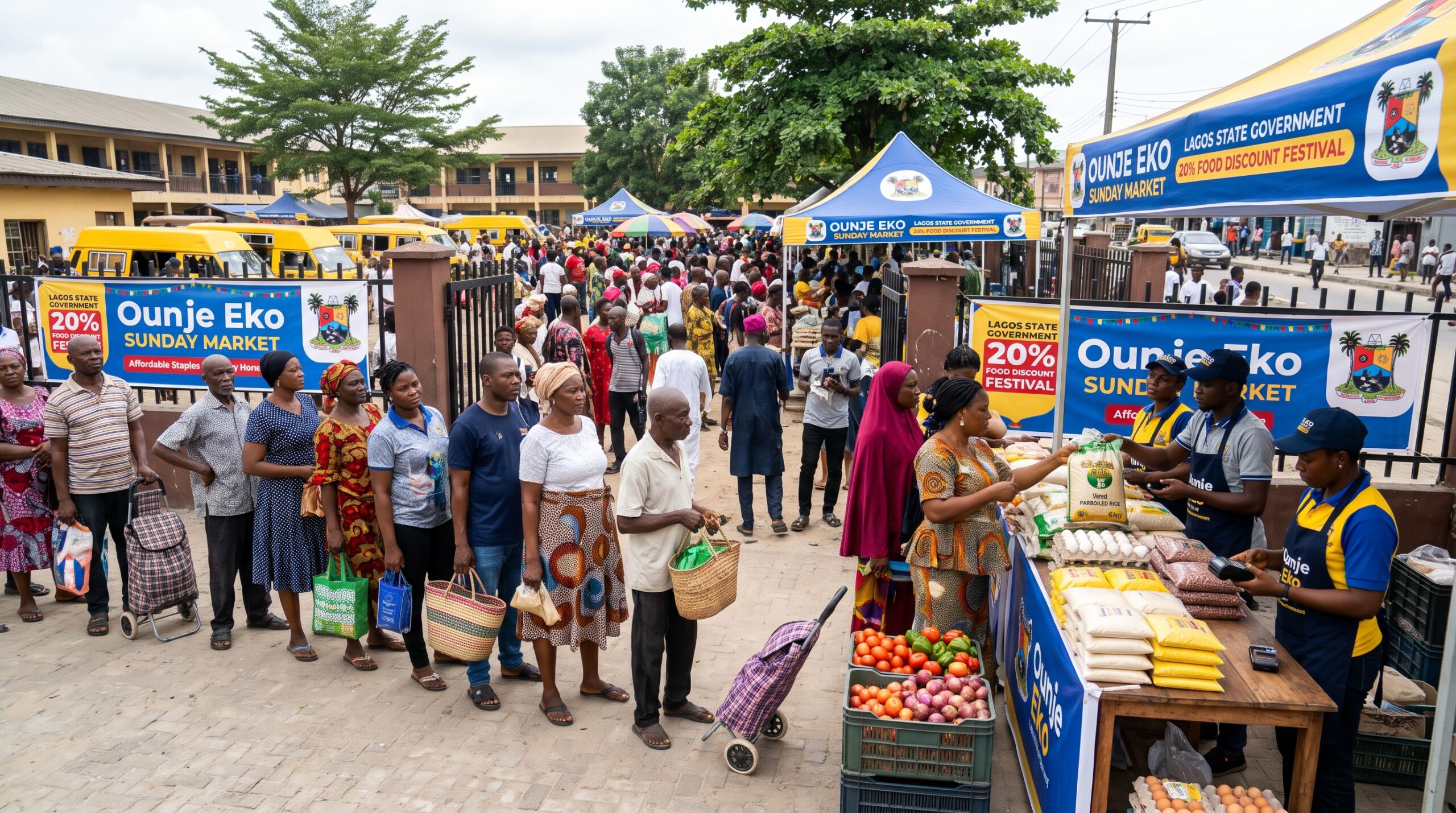
As the festive season approaches across Nigeria’s commercial capital, the Lagos State Government has officially announced the return of its flagship subsidized food market initiative, Ounje Eko, offering residents a 20 percent discount on essential staple foods. Designed to cushion households against persistent food inflation and year-end spending pressures, the intervention restores Sunday pop-up markets across the state’s five administrative divisions, giving millions of Lagosians direct access to affordable rice, garri, beans, bread, eggs, and fresh produce ahead of the December holidays.
For everyday families navigating elevated transport fares, utility bills, and grocery costs, the revival of Ounje Eko provides immediate, practical relief at the dining table. Beyond short-term festive affordability, the program reflects a broader state strategy to compress agricultural supply chains, eliminate middleman markups, and link smallholder farmers directly with urban consumers. Understanding how the 2026 festive edition works requires examining what items are included in the discount basket, where the markets operate across Lagos, the digital payment and purchase limits enforced to prevent hoarding, and how the initiative fits into the state’s long-term food security architecture.
Inside the Festive Ounje Eko Revival
Originally launched as an emergency response to acute cost-of-living pressures, Ounje Eko quickly established itself as one of the most visible social welfare and food stabilization programs in Lagos State. By bypassing multiple layers of wholesale intermediaries and absorbing logistics and packaging overheads, the state government enables residents to purchase staple foods at 20 percent below prevailing open-market retail prices.
Coordinated through the Lagos State Ministry of Agriculture and Food Systems alongside the Lagos Commodities and Futures Exchange (LCFE) and designated market operators, the festive edition is timed specifically for late November and December. Historically, food prices across Mile 12, Ketu, Oyingbo, Alaba Rago, and neighborhood retail stalls surge during the final six weeks of the year due to heightened holiday demand, festive travel, and seasonal hoarding by speculators.
By reintroducing Ounje Eko across strategic local government areas and local council development areas (LCDAs), the state aims to achieve two immediate goals:
-
Direct Household Relief: Putting more food on the table for low- and middle-income families during a period when household budgets are stretched by school fees, year-end rent renewals, and holiday obligations.
-
Open-Market Price Moderation: Creating competitive downward pressure on private food vendors, discouraging artificial price gouging during the Christmas and New Year rush.
What Is in the Ounje Eko 20% Discount Food Basket?
A major strength of the Ounje Eko initiative lies in its focus on everyday Nigerian dietary staples rather than obscure commodities. Rather than distributing arbitrary relief boxes, the markets operate as structured retail outlets where shoppers select and pay for the exact items their households need.
The staple food basket covered under the 20 percent discount includes:
-
Local Parboiled Rice: Packaged in manageable household sizes (such as 1kg, 2.5kg, and 5kg bags) to ensure wide distribution rather than bulk buyouts by commercial resellers.
-
Garri (Yellow and White): Sourced directly from cassava processing clusters in Epe, Ikorodu, Badagry, and neighboring southwestern states, packed hygienically for immediate kitchen use.
-
Beans (Oloyin and Drum Varieties): Cleaned, sorted, and pre-weighed in consumer-friendly portions to eliminate market measurement discrepancies.
-
Fresh Farm Eggs: Supplied directly from Lagos poultry estates and partner farms at factory-gate prices minus the 20 percent state subsidy.
-
Sliced Bread and Bakery Staples: Produced by partnered Lagos bakeries adhering to strict weight and quality standards.
-
Fresh Produce and Perishables: Tomatoes, scotch bonnet peppers (ata rodo), onions, and vegetable oil sold at discounted rates depending on weekly harvest arrivals.
Where and When the Markets Operate Across Lagos
To ensure equitable access across a sprawling megacity of more than 20 million residents, the Lagos State Government structures Ounje Eko around decentralized Sunday markets spread across all five historical divisions of the state, known collectively as IBILE: Ikorodu, Badagry, Ikeja, Lagos Island, and Epe.
Operating on Sundays serves a deliberate logistical and social purpose. Most civil servants, artisans, corporate workers, and informal traders have lighter schedules on Sundays, allowing families to shop calmly without weekday traffic gridlock. Furthermore, public school compounds, local council secretariats, and designated community centers are empty on Sundays, providing spacious, fenced venues with ample parking, crowd control gates, and security coverage.
Key market zones across the five divisions include:
-
Ikeja Division: Venues spanning Ikeja, Alimosho (one of the state’s most densely populated corridors), Agege, Ifako-Ijaiye, Oshodi-Isolo, Mushin, Somolu, and Kosofe.
-
Lagos Island Division: Accessible locations serving Lagos Island, Eti-Osa, Ikoyi-Obalende, and Victoria Island corridors, alongside Surulere and Lagos Mainland.
-
Ikorodu Division: Dedicated centers in Ikorodu Central, Igbogbo-Baiyeku, and Imota, situated close to the state’s flagship rice milling infrastructure.
-
Badagry Division: Markets covering Badagry Central, Ojo, Amuwo-Odofin, and Ajeromi-Ifelodun to serve the densely populated southwestern axis.
-
Epe Division: Distribution points in Epe Central, Eredo, and Ibeju-Lekki, connecting coastal and agrarian communities directly with state-backed food supplies.
Gates typically open early on Sunday mornings, with orderly queuing systems managed by officials from the Ministry of Agriculture, Lagos Neighbourhood Safety Corps (LNSC), and local council task forces.
Cashless Payments, Purchase Caps, and Anti-Hoarding Safeguards
During earlier editions of subsidized food interventions in Nigeria, two operational threats frequently undermined public trust: cash handling leakages at sales points and commercial traders buying up discounted stock to resell at full price in regular markets on Monday morning. To protect the integrity of the festive Ounje Eko rollout, the Lagos State Government enforces strict digital and quantity controls.
1. Strictly Cashless Transactions
No physical naira notes are accepted inside Ounje Eko market venues. All purchases are processed electronically via Point-of-Sale (POS) terminals, debit cards, instant bank transfers, or approved digital payment wallets. Going 100 percent cashless eliminates cash theft, speeds up checkout queues, creates an auditable trail for every naira collected, and ensures smooth reconciliation between state authorities and participating agro-vendors.
2. Household Purchase Quotas
To guarantee that thousands of individual residents benefit rather than a handful of bulk buyers, strict per-person purchase caps apply to every commodity. A shopper may, for instance, be limited to one 5kg bag of rice, one crate of eggs, and set quantities of garri and beans per market visit. Marshals and checkout software flag attempts to bypass these limits.
3. Standardized Pre-Packaging and Price Tags
Every item entering an Ounje Eko venue arrives pre-weighed, sealed, and clearly labeled with both the standard market reference price and the 20 percent discounted Ounje Eko price. Shoppers do not have to haggle over tin measurements (derica or olodo), ensuring complete transparency from entry to exit.
Supporting Local Farmers and Agro-Processors Behind the Scenes
While shoppers experience Ounje Eko as a Sunday retail discount, the program functions equally as an economic stimulus for Lagos State’s agricultural ecosystem. Rather than importing finished foreign food products to flood local markets, the Ministry of Agriculture and Food Systems sources heavily from domestic producers, aggregators, and processors.
This farm-to-market linkage creates a mutually reinforcing cycle:
-
Guaranteed Off-Take for Farmers: Poultry farmers in Ikorodu and Epe, cassava processors in Badagry, and vegetable growers in state-supported greenhouse estates receive predictable, high-volume purchase orders ahead of the festive season.
-
Boosting Utilization at Imota Rice Mill: The 32-metric-ton-per-hour Imota Rice Mill, one of the largest integrated rice milling facilities in Sub-Saharan Africa, plays a central role in supplying clean, locally milled rice to the Ounje Eko ecosystem.
-
Empowering Youth and SME Agro-Vendors: Packaging, logistics, cold-chain transport, and market stall operations employ hundreds of young Lagosians, logistics startups, and small-scale food aggregators throughout the festive run.
Practical Tips for Shoppers Planning to Visit Ounje Eko
Because the 20 percent festive discount attracts substantial turnout across every local government area, arriving prepared makes the shopping experience smooth and stress-free. Residents planning to visit an Ounje Eko market center should keep five practical tips in mind:
-
Arrive Early: Popular staples such as 5kg bags of rice, crates of eggs, and cooking oil often sell out by early afternoon. Arriving between 8:00 AM and 10:00 AM gives shoppers the widest selection across all stalls.
-
Carry Active ATM Cards and Digital Banking Apps: Because cash is strictly prohibited, ensure your debit card is active and carry a backup payment option (such as a secondary bank card or mobile banking app) in case of temporary network delays on a specific bank switch.
-
Bring Sturdy Reusable Shopping Bags: While items are pre-packaged in sealed nylons or sacks, bringing strong tote bags or a small trolley makes carrying multiple items from the checkout point to public transport much easier.
-
Verify Official Venue Lists: Before leaving home on Sunday morning, check verified announcements from the Lagos State Ministry of Agriculture and Food Systems or your local council secretariat to confirm the exact school or community center hosting the market in your area.
-
Follow Queue Marshals’ Instructions: Elderly citizens, pregnant women, and persons living with disabilities are typically accorded priority lanes at Ounje Eko venues. Cooperating with safety marshals keeps checkout lines moving briskly for everyone.
Beyond Festive Discounts: Lagos State’s Long-Term Food Security Strategy
The festive return of Ounje Eko arrives alongside broader, structural investments aimed at insulating Lagos State from national food supply shocks over the long term. Because Lagos consumes over 50 percent of the food traded in southwestern Nigeria while occupying just 0.4 percent of the nation’s landmass, the state cannot rely solely on temporary price subsidies.
To build permanent food resilience, Lagos is executing several foundational projects:
-
The Lagos Central Food Security Systems and Logistics Hub (Ketou-Epe): Designed as the largest wholesale food logistics hub in West Africa, the Epe facility integrates cold storage, dry warehousing, quality-control laboratories, and structured commodity trading to cut post-harvest losses that currently waste up to 40 percent of perishable produce entering the state.
-
Middle-Level Agro-Produce Hubs: Complementing the main Epe hub, decentralized food hubs in Mushin, Agege, and Abijo bring modern storage and clean wholesale trading closer to urban neighborhoods.
-
Inter-State Agricultural Partnerships: Through bilateral agreements with food-producing states across northern and central Nigeria, Lagos secures dedicated agricultural land and direct rail-and-road supply corridors for grains, livestock, and tubers.
In the immediate term, however, the revival of Ounje Eko with a 20 percent discount delivers what Lagosians need most right now: tangible relief at the market gate, fairer prices during the peak festive season, and a reassuring reminder that food affordability remains a top priority for the state.