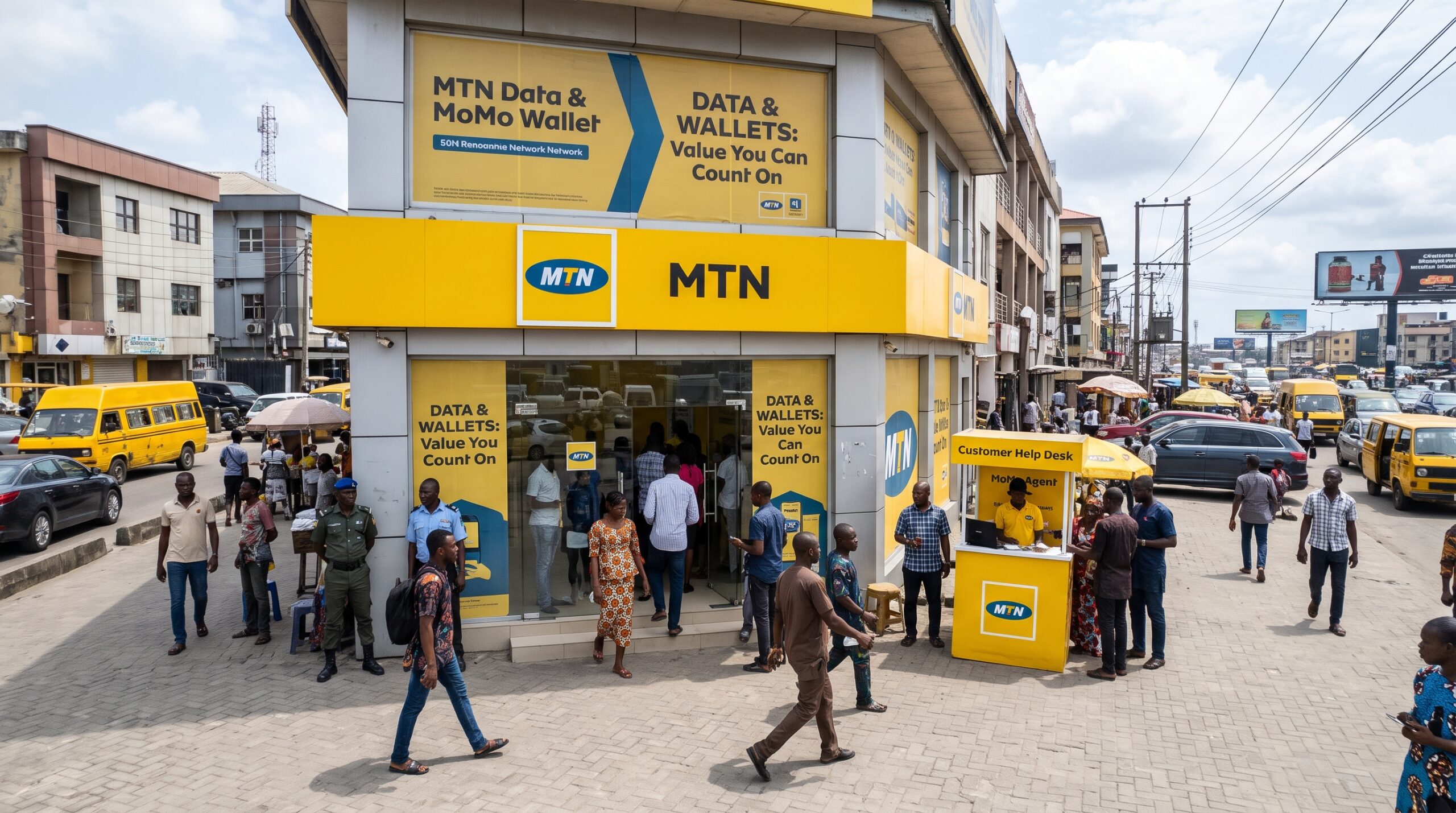
In the bustling commercial corridors of Lagos, Kano, and Port Harcourt, two quiet transformations have reshaped how millions of Nigerians interact with the digital economy. The first happens every time a smartphone screen lights up to renew an expiring internet bundle. The second takes place inside mobile money accounts where users store, transfer, and settle daily expenses. For MTN Nigeria Communications Plc, the country’s largest telecommunications operator, data connectivity and digital wallets are no longer mere utility offerings. They have evolved into high-value engines that require both higher consumer spending and stronger institutional valuation.
Over the past two years, the economics of Nigerian telecommunications underwent a seismic recalibration. After more than a decade of static retail tariffs, regulatory approvals in early 2025 unlocked a long-awaited upward adjustment in voice and data pricing. Simultaneously, MTN’s fintech subsidiary, MoMo Payment Service Bank (MoMo PSB), navigated platform migrations, regulatory compliance hurdles, and fierce competition from nimble digital banks to rebuild its active wallet ecosystem. By the third quarter of 2026, the financial results of this dual shift became unmistakable. Service revenue surged, profitability rebounded from prior foreign exchange losses, and wallet balances expanded more than fourfold.
Yet behind the impressive corporate balance sheets lies a complex economic story. Consumers are paying significantly more per megabyte of data, businesses are recalibrating their operational budgets around connectivity, and mobile money platforms are demanding higher transaction density and float retention to justify their infrastructure costs. Understanding why data and wallets demand a higher price requires examining the infrastructure realities, macroeconomic pressures, and strategic pivots defining MTN Nigeria’s current chapter.
The End of the Decade-Long Tariff Freeze
For eleven years between 2013 and early 2025, retail telecommunications tariffs in Nigeria remained frozen despite relentless macroeconomic headwinds. During that period, the naira experienced severe devaluations, consumer price inflation climbed into double digits, and the cost of diesel required to power thousands of off-grid base transceiver stations multiplied several times over. Telecom operators absorbed these escalating expenses while attempting to maintain network quality for an ever-expanding base of internet users.
The breaking point arrived in 2024 when MTN Nigeria posted a historic after-tax loss of ₦400.4 billion, driven largely by foreign exchange losses on dollar-denominated tower leases and equipment financing. Negative retained earnings and depleted shareholders’ equity underscored an industry-wide reality: the existing pricing model was unsustainable. In January 2025, the Nigerian Communications Commission (NCC) authorized a maximum 50 percent upward tariff adjustment across the sector.
When MTN Nigeria began implementing these revised prices in February 2025, the impact on consumer wallets was immediate. Popular monthly bundles shifted noticeably:
-
Entry-level monthly plans: The longstanding 1.5GB monthly plan at ₦1,000 transitioned to a 1.8GB bundle priced at ₦1,500, representing a 50 percent increase in cash outlay for budget-conscious subscribers.
-
Mid-tier data bundles: The 15GB monthly plan rose from ₦4,500 to ₦6,500, while the 20GB monthly plan moved from ₦5,500 to ₦7,500.
-
Heavy enterprise and household packages: High-capacity 90-day bundles saw steeper adjustments, with the 600GB plan climbing from ₦75,000 to ₦120,000 and the 1.5TB plan rising from ₦150,000 to ₦240,000.
The rollout was not without friction. An initial mispricing on a 15GB weekly digital bundle briefly pushed its cost up by 200 percent, triggering widespread outrage on social media and prompting a rare, colloquial public apology from the operator before the price was corrected. Consumer advocacy groups, including the National Association of Telecommunications Subscribers, protested the broader tariff hike and threatened legal challenges. Despite the public pushback, economic necessity prevailed. Without higher revenue per gigabyte, network operators could not fund the capital expenditure needed to prevent widespread congestion and service degradation.
Rebuilding the Balance Sheet Through Data Monetization
The financial turnaround following the tariff repricing demonstrated just how central data monetization has become to MTN Nigeria’s survival and growth. In its audited full-year results for 2025, the company reported that service revenue climbed 55.1 percent to ₦5.2 trillion, anchored by a 74.5 percent surge in data revenue. Profit after tax rebounded dramatically to ₦1.1 trillion, enabling the company to restore positive retained earnings of ₦400.4 billion and resume dividend payments to shareholders.
That momentum carried firmly into 2026. By the end of the third quarter on September 30, 2026, MTN Nigeria’s nine-month service revenue rose another 23.7 percent to ₦4.6 trillion, while profit after tax jumped 55.3 percent to ₦1.2 trillion. Earnings before interest, taxes, depreciation, and amortization (EBITDA) reached ₦2.6 trillion, pushing the EBITDA margin to an impressive 56.9 percent.
The numbers reveal an important behavioral reality: even at higher prices, Nigerian consumers did not abandon mobile internet. Between December 2025 and September 2026, MTN Nigeria added four million active data users, bringing the total to 57.2 million. Data has become an essential utility on par with electricity and transportation. Students rely on it for lectures, traders use WhatsApp and Instagram as primary storefronts, and remote workers depend on mobile hotspots to stay employed. Because demand is relatively inelastic, higher tariffs translated directly into stronger cash flows rather than mass subscriber churn.
The Hidden Infrastructure Cost Behind Every Megabyte
To understand why data demands a higher price from an engineering perspective, one must look beyond the retail bundle menu and examine what happens behind the cell tower. Delivering high-speed data across a nation of more than 220 million people requires continuous, capital-intensive investment. In 2025 alone, MTN Nigeria more than doubled its capital expenditure (excluding leases) to ₦1 trillion, representing a capex intensity of 19.3 percent. In the first nine months of 2026, the company deployed an additional ₦864.8 billion into network infrastructure.
Several structural cost pressures dictate why mobile data cannot be priced cheaply in Nigeria:
-
Power Generation and Energy Transition: Nigeria’s national power grid remains unreliable, forcing telecom operators to run thousands of sites on diesel generators and hybrid solar-battery systems. While MTN Nigeria avoided approximately ₦8.3 billion in diesel costs during the first nine months of 2026 through solar deployments and energy efficiency initiatives, energy still accounts for one of the largest components of direct network operating expenses.
-
Spectrum and Capacity Expansion: As video streaming, cloud applications, and social media video feeds dominate internet traffic, network congestion becomes a constant threat. Acquiring additional spectrum, such as the 2.6GHz band, and upgrading base stations to handle massive data throughput require foreign currency outlays for radio equipment imported from global vendors.
-
Fiber-to-the-Home (FTTH) Offloading: Mobile radio spectrum is finite. To prevent mobile networks from buckling under heavy household streaming, MTN has prioritized rolling out fiber optic cables directly into homes and offices. By September 2026, FTTH infrastructure was carrying roughly 13 percent of MTN Nigeria’s total data traffic, freeing up mobile spectrum for users on the move. Building physical fiber trenches across dense Nigerian cities, however, involves steep right-of-way fees, civil engineering costs, and frequent repairs from road construction damage.
-
Tower Lease Obligations: Even after renegotiating tower lease agreements with partners like IHS Holdings to reduce dollar exposure, lease liabilities and site maintenance remain heavy fixed obligations. Every new 4G or 5G radio added to a tower increases rental and power charges.
When subscribers purchase a ₦1,500 or ₦7,500 data bundle, they are effectively financing a private power utility, a nationwide fiber network, and continuous hardware upgrades. Higher retail pricing is the mechanism that bridges the gap between exploding bandwidth consumption and the physical cost of maintaining network uptime.
MoMo PSB and the Economics of Digital Wallets
While data connectivity forms the core of MTN Nigeria’s balance sheet, its mobile money subsidiary, MoMo Payment Service Bank, represents its most ambitious long-term bet. For years, telecom operators in Nigeria watched from the sidelines as independent fintech startups like OPay, PalmPay, and Moniepoint captured the country’s retail payment boom. When MTN finally secured its Payment Service Bank license, expectations were high that its massive GSM subscriber base would effortlessly convert into tens of millions of active mobile money users.
Reality proved far more demanding. Building a profitable digital wallet ecosystem in Nigeria requires overcoming deeply entrenched consumer habits, strict Know-Your-Customer (KYC) regulations enforced by the Central Bank of Nigeria, and razor-thin transaction margins.
During 2026, MTN Nigeria’s fintech division experienced a transitional period marked by deliberate restructuring. Overall fintech revenue declined by 25.9 percent to ₦97.5 billion in the first nine months of 2026, primarily due to a temporary suspension of its airtime and data credit service between April and June while the company transitioned to a multi-partner lending model. However, beneath that headline dip, the core mobile money business told a remarkably different story.
In the nine months ended September 30, 2026, MoMo PSB’s core mobile money revenue surged by 102.2 percent. Two key metrics drove this expansion:
-
Quadrupling of Customer Wallet Balances: Total funds held inside customer MoMo wallets jumped more than fourfold from December 2025 levels to reach ₦43.8 billion. In digital banking, float income—the interest earned on pooled customer deposits—is a critical revenue pillar. Higher wallet balances meant MoMo PSB could generate substantial float revenue without relying solely on punitive user fees.
-
Platform Modernization and Volume Acceleration: In August 2026, MoMo PSB migrated its core infrastructure to the Alipay+ platform. Following the migration, third-quarter transaction volumes leaped 69.1 percent compared to the second quarter, while monthly active wallet users grew 11.6 percent year-on-year to 3.2 million.
Yet 3.2 million active wallets out of 94.7 million total mobile subscribers highlights the scale of the challenge ahead. MTN Group’s Ambition 2030 strategy targets 20 million active MoMo wallets in Nigeria by the end of the decade. Achieving that nearly sevenfold increase requires persuading millions of casual airtime buyers to treat MoMo not as a backup USSD tool, but as their primary financial account.
Why Wallets Demand a Higher Price from Both Users and Operators
The phrase “wallets demand a higher price” carries a dual meaning in the context of MTN Nigeria’s fintech strategy. On one side, operating a compliant, fraud-resistant payment bank demands a higher capital and operational price from MTN. On the other side, digital wallets increasingly demand a higher share of the consumer’s financial life—and subtly extract value through tiered fee structures and ecosystem lock-in.
Consider the competitive dynamics of Nigerian retail payments. Fintech challengers conditioned Nigerian consumers to expect near-zero fees on bank transfers and instant cashback on utility purchases. To compete, MoMo PSB publishes highly aggressive consumer rates:
-
-
Interbank Transfers: A flat fee of ₦10 regardless of the transfer amount, making a ₦50,000 transfer cost just 0.02 percent.
-
Merchant Payments: Zero charge when paying registered MoMo merchants.
-
Self-Service Airtime and Data: Zero transaction fees, often bundled with 2 percent cashback or promotional airtime bonuses.
-
If consumer-facing digital transfers are practically free, where does the higher price emerge? It surfaces across three distinct layers of the ecosystem:
1. Cash-In, Cash-Out, and Agent Economics
Nigeria remains heavily reliant on physical cash in open markets, transport hubs, and rural communities. Bridging physical cash and digital wallets requires a vast network of human Point-of-Sale (POS) agents. At MoMo agent locations, physical cash withdrawals and deposits carry tiered charges: ₦50 for transactions between ₦1,000 and ₦5,000, ₦100 for amounts between ₦6,000 and ₦20,000, and ₦300 for transactions above ₦20,000 up to ₦500,000. Bill payments processed through agent terminals also attract a ₦100 service fee. For everyday market traders and rural residents who operate outside smartphone apps, converting physical naira into digital wallet value carries an unavoidable percentage cost.
2. Tiered KYC and Wallet Liquidity
To unlock higher transaction limits—moving from Tier 1 (₦50,000 single deposit cap and ₦300,000 maximum balance) to Tier 2 (₦200,000 deposit cap and ₦500,000 balance) or Tier 3 (₦5,000,000 single deposit cap with no balance limit)—users must surrender higher levels of personal identity verification, including their Bank Verification Number (BVN) and National Identification Number (NIN). In return for frictionless limits, users park larger sums of idle cash in the wallet. The ₦43.8 billion in aggregate wallet balances demonstrates that customers are paying an opportunity cost—forgoing interest they might earn in treasury bills or high-yield savings accounts—in exchange for the convenience of instant mobile liquidity.
3. Credit and Value-Added Services
Zero-fee transfers are customer acquisition tools; credit and merchant services are the monetization engines. When MTN resumed its airtime and data credit service in the third quarter of 2026 under a multi-partner model, revenue from that single segment jumped 78.5 percent quarter-on-quarter. Millions of subscribers who run out of data or airtime mid-day willingly pay convenience fees on micro-loans to stay connected. As MTN pushes toward broader digital lending and cross-border payments via Alipay+, credit margins and merchant acquiring fees will carry the financial weight that basic peer-to-peer transfers cannot.
The Consumer Squeeze: Navigating Rising Digital Costs
For the average Nigerian household, the convergence of higher data tariffs and expanding digital wallet usage has created a noticeable squeeze on disposable income. Telecommunications and digital financial services are no longer discretionary line items; they function like a daily tax on economic participation.
Consider the monthly digital expenditure of a typical young professional or small business owner in Lagos or Abuja in late 2026:
-
Primary Mobile Data: Maintaining constant connectivity for work emails, cloud documents, navigation apps, and social media requires at least 20GB to 36GB per month. On MTN’s rate card, a 20GB monthly plan sits around ₦7,500, while a 36GB bundle runs roughly ₦11,000.
-
Secondary or Home Connectivity: Households relying on 5G routers or fiber-to-the-home connections easily spend between ₦25,000 and ₦45,000 monthly for larger data caps or unlimited speed tiers.
-
Wallet and Transaction Friction: While individual bank transfers cost ₦10, frequent micro-transactions, POS cash withdrawals for street-level purchases, and emergency airtime advances quietly add several thousand naira in monthly fees.
To cope with these higher prices, Nigerian consumers have become remarkably strategic in how they consume bandwidth and manage wallets. Data rationing is now commonplace. Users disable automatic app updates, switch video streaming platforms to standard definition, and schedule heavy downloads for discounted night-browsing windows. Many maintain dual-SIM smartphones, actively comparing promotional bonuses across MTN, Airtel, and Globacom before purchasing a bundle.
Simultaneously, consumers have grown far less tolerant of unexplained data depletion or failed wallet transactions. When a gigabyte costs significantly more than it did two years ago, subscribers scrutinize every megabyte lost to background processes. Telecom operators face heightened pressure to deliver transparent usage tracking and reliable network speeds; charging premium prices for sluggish connections invites immediate backlash and regulatory scrutiny.
Regulatory Pressures and Quality of Service Mandates
Higher prices bring higher expectations, not just from consumers, but from the Nigerian Communications Commission and the Central Bank of Nigeria. When the NCC approved the 50 percent tariff increase in January 2025, the approval came tethered to strict performance commitments. Regulators made it clear that operators could no longer blame frozen tariffs for dropped calls, slow download speeds, or prolonged network outages.
Throughout 2025 and 2026, regulatory oversight intensified across two fronts:
-
Network Quality and Capex Accountability: Operators were required to demonstrate measurable improvements in network key performance indicators, including call setup success rates, data throughput, and rural coverage expansion. MTN Nigeria’s massive capital expenditure ramp-up—exceeding ₦1.86 trillion combined across 2025 and the first nine months of 2026—was both a commercial necessity and a regulatory imperative.
-
Fintech Security and Consumer Protection: As mobile money balances swelled into the tens of billions of naira, the Central Bank tightened rules around agent banking, transaction monitoring, and cybersecurity. Payment Service Banks must maintain strict capital adequacy ratios, enforce real-time fraud detection, and ensure instant reversal of failed electronic transactions. Compliance requires continuous software investment, further raising the baseline cost of running a digital wallet.
Additionally, MTN Nigeria has worked to secure regulatory approvals to acquire full ownership of IHS Holdings’ tower assets, a strategic move expected to conclude by the end of 2026. Bringing tower infrastructure back under direct control aims to streamline network maintenance, accelerate renewable energy integration, and insulate future margins from third-party lease escalations.
What Lies Ahead for Nigeria’s Digital Economy
The story of MTN Nigeria’s data pricing and mobile wallet evolution offers a clear window into the maturation of Africa’s largest digital market. For over a decade, Nigerian consumers benefited from artificially suppressed telecom tariffs that masked the true cost of building infrastructure in a challenging macroeconomic environment. That era has permanently closed.
Looking forward, three trends will define how data and wallets interact with consumer finances:
-
Convergence of Connectivity and Finance: MTN will increasingly bundle data incentives with MoMo wallet usage. Offering free data bonuses for funding a wallet, paying utility bills through the MoMo app, or transacting with registered merchants creates a self-reinforcing loop. Data drives wallet engagement, while wallet float and credit revenue help subsidize customer retention.
-
Shift Toward Fixed Wireless and Fiber: As mobile data prices remain elevated, households and small businesses will increasingly migrate toward shared fixed-wireless routers and fiber-to-the-home connections, where the cost per gigabyte is substantially lower than individual mobile bundles.
-
Value-Based Pricing Over Volume Discounts: Rather than competing purely on cheap gigabytes, telecom and fintech operators will differentiate through reliability, bundled digital content, instant micro-credit, and seamless cross-border payments.
For MTN Nigeria, demanding a higher price for data and building deeper value inside digital wallets rescued the company from a severe financial crisis and restored it to robust profitability. For millions of Nigerians, however, the adjustment serves as a daily reminder that in an increasingly connected economy, access to the internet and digital money is both indispensable and undeniably more expensive than ever before.